
Most buyers weighing plastic against FRP already have plastic tanks on a stand at an estate, block of flats or factory, or a quote for more. The decision is whether to keep adding plastic tanks or move the supply into one FRP/GRP sectional tank. On a single house or small building, plastic remains a sound choice.
What a “fibreglass tank” means
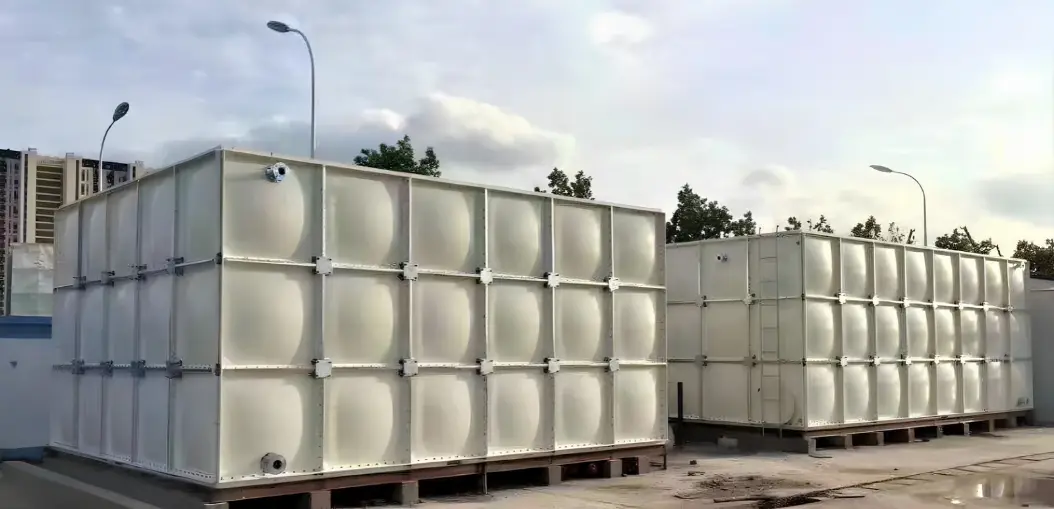
FRP stands for fibre-reinforced plastic. Our tanks are reinforced with glass fibre, which is why they are also called GRP (glass-reinforced plastic) or fibreglass tanks. The panels are SMC GRP, short for sheet moulding compound.
Plastic (polyethylene) tanks are delivered in one piece. So the plastic vs fiberglass tank question is one-piece plastic against glass-reinforced panels bolted together on your site.
How big each tank can be
A plastic tank tops out at about 10,000 litres. A larger supply needs several tanks, each on its own stand or slab.
An FRP/GRP sectional tank starts at 5,000 litres and has no fixed maximum. It is built up from panels of 2m × 2m, 1m × 1m and 1m × 0.5m, in standard heights of 1.0m, 1.5m, 2.0m, 2.5m and 4.0m. Common sizes run from 5,000 litres to 100,000 litres and above, all in one tank.
Footprints for common sizes:
| Capacity | Length × width × height |
|---|---|
| 5,000 L | 2m × 2m × 1.5m |
| 10,000 L | 2.5m × 2m × 2.0m |
| 20,000 L | 4m × 3m × 2.0m |
| 30,000 L | 4m × 4m × 2.0m |
| 50,000 L | 6m × 4m × 2.5m |
| 100,000 L | 8m × 5m × 2.5m |
To see which side of the 10,000-litre line you are on, use the sizing method: people served × 120 litres per person per day × days of storage. The 120 litres is the planning value for urban supply in the Nigerian Water Supply and Sanitation Policy. As an example, 100 residents need 12,000 litres for a single day, already more than one plastic tank holds.
If a Braithwaite tank is also on your list at these sizes, see Braithwaite vs FRP tanks, or choosing a water tank for estates and factories for Braithwaite, plastic and FRP/GRP side by side.
HDPE vs FRP tank: which lasts longer
A plastic tank lasts 10 to 15 years. Upkeep is cleaning the inside and checking the walls for sun cracks. Once the plastic turns brittle, the tank is replaced.
Our FRP/GRP tanks last about 40 to 50 years when properly maintained. A maintenance visit drains, cleans and disinfects the inside, then checks the bolts, joints and fittings for leaks. The first 6 months of servicing and defect repair are free and written into the contract. After that, clean the tank once a year.
What the sun does to each
Sun is the weak point of a plastic tank. After long exposure, the plastic turns brittle and cracks. If light gets through the walls, algae can grow inside, in the water you store.
An FRP/GRP tank standing outdoors can take a UV-resistant coating. Ask for it at the inspection if the tank will stand in the open, on a rooftop in Lagos or a factory yard in Ogun State.
Drinking water
Every FRP/GRP tank we install uses food-grade resin, the kind used for drinking water, so the tank won’t taint what it stores. You can check the panel material before you sign: sample panels are available during the bid. For a plastic tank, ask its supplier what the tank is made of before you buy.
How each is installed
A plastic tank is delivered in one piece and set on a stand or slab.
An FRP/GRP tank is built where it will stand:
- The base. A cement base or a metal stanchion, built to the height the site needs. We build it, or you have it ready before we arrive.
- The panels. They are delivered to site and bolted together. On a tight site, they are carried in by hand.
- The fittings. Ballcock, overflow, outlet valve, inlet, vent, manhole cover and ladder come on every tank.
- The 24-hour fill test. The tank is filled to full capacity and left standing for 24 hours. Every joint and bolt is checked for leaks, and the tank is checked level. You supply the water for the test.
A tank can also stand on a roof once a structural engineer has signed the roof off. FortevaWorks arranges the sign-off.
My estate has outgrown its plastic tanks: what now?
The most common reason an estate runs short is storage sized for fewer residents than now live there. FortevaWorks does not supply plastic tanks, so for a site that has outgrown them there are two routes:
- Add an FRP/GRP sectional tank beside them, sized with the method above to cover the residents the plastic tanks cannot.
- Replace them, once the plastic has turned brittle or cracked. The old tanks keep supplying until the new tank passes its fill test.
The days of storage are set at our free site inspection, from how reliable your borehole, mains and power supply are. FortevaWorks has worked on more than 20 FRP/GRP tank installations for residential estates. Our guide to water storage for estates covers the other causes of shortage, such as leaks and pump failures.
Can an FRP tank be extended later?
Yes. An existing FRP/GRP sectional tank is opened up, panels are added and it is resealed. A plastic tank cannot be extended: a second tank goes beside it, or it is replaced. Where a second tank can carry the estate, supply continues while the extension work is done. The additional cost is set after the site visit. If you expect more residents or a second factory line, start with a sectional tank you can extend.
Get a tank sized for your site
Tell us how many people the supply serves and where the tank will stand: ground, stanchion or rooftop. We inspect the site free, then send a detailed quotation, with a technical drawing if you want one. Our guide to FRP tank costs explains each cost factor in the table above. Read about our FRP/GRP water tanks and the water storage systems service, or contact us to book the inspection.