
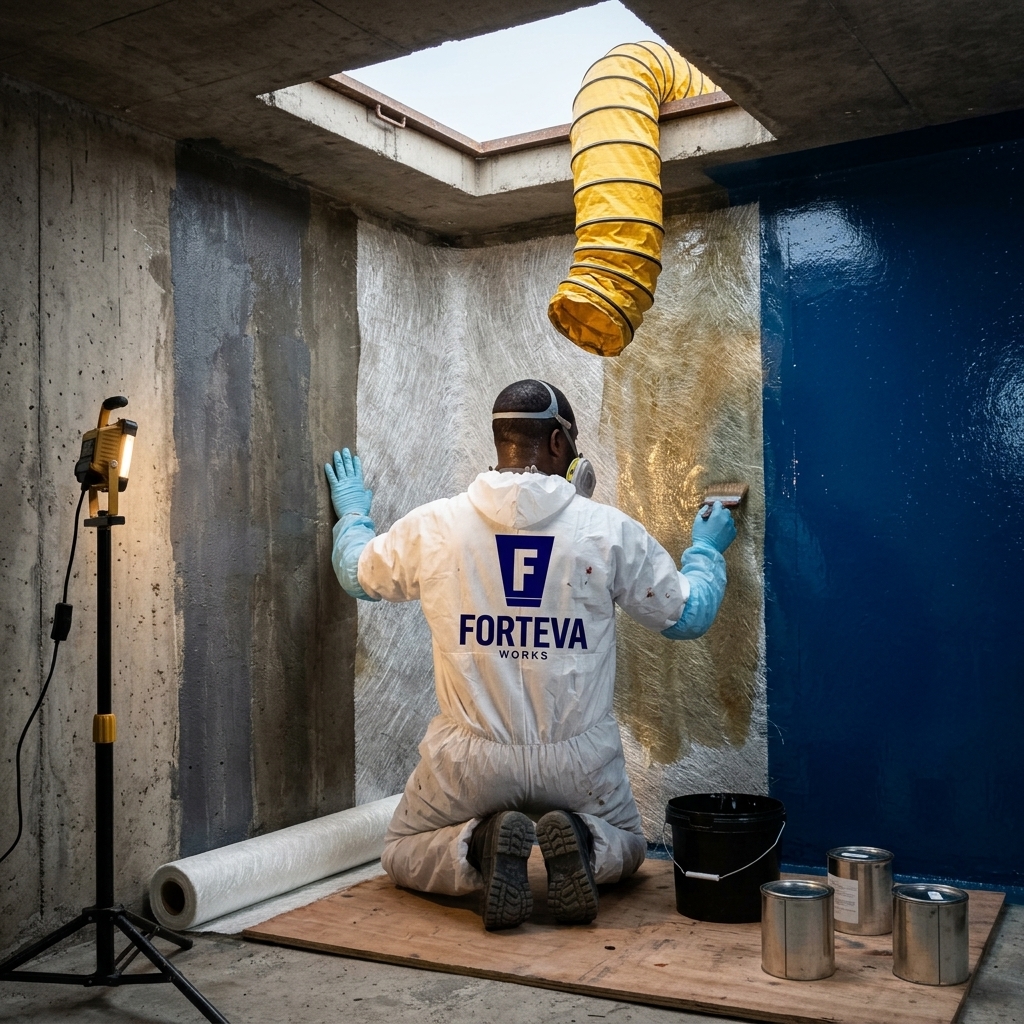
A fibreglass lining is a layer of resin reinforced with glass fibre, laid on the inside of a tank, pit or sump to stop leaks and protect the surface from corrosion. FRP (fibre-reinforced plastic) and GRP (glass-reinforced plastic) name the same family of material. We line concrete and steel tanks of any size, underground, at ground level or on a roof, anywhere in our service areas.
What we line
We line concrete tanks, steel tanks, pits and sumps (the low chambers where water or effluent collects). There is no size limit. To work inside, we need a manhole at least 600mm across.
What we line for each sector:
- Estates: underground concrete water tanks.
- Factories: process-water and effluent pits.
- Food and beverage plants: water tanks.
- Oil and gas sites: sumps and bunds (the walls that hold a spill around a tank).
Tell us at the enquiry stage what the tank holds today and where it stands.
How a lining job runs
- Drain, dry and prepare. The tank is drained and dried. Concrete is ground, its cracks are filled with resin mortar (resin mixed with a filler, which sets hard), and it is moisture-tested so the lining does not go onto damp concrete. Steel is blasted to bare metal. Any leaks are fully repaired first.
- Primer or bonding agent, so the first layer bonds to the surface instead of lifting from it.
- Layup: layers of glass fibre are laid on and wetted out with resin.
- Curing: the lining cures, and the tank is refilled 7 days after the final coat.
- Test with you: adhesion, tap test, thickness and finish, as set out below.
- Wash, flush and hand over: the tank is washed and flushed before first use, and you receive the handover documents.
You receive photos and video by email at each milestone, so you see the prepared surface before the lining covers it. Repair work found at the free site inspection is listed as separate line items in the quotation.
The laminate system
A laminate is the build-up of resin and glass fibre layers that forms the lining. The resin is polyester, vinyl ester or epoxy, and the glass, the number of layers and the finished thickness are set for each job. All of them are stated in your quotation, and the material in the quotation is the material we install. A gelcoat, the resin top coat that forms the face of the lining, can be added in a custom finish and colour. Extra reinforcement layers can be added for strength, and fire-resistant or UV-resistant coatings are available.
If the tank holds drinking water, tell us when you enquire, because that decides the resin.
Tests before handover
We run the final inspection with you before handover, on every job:
- Adhesion: a pull-off test, which pulls a small disc bonded to the lining to check it is firmly bonded to the surface beneath.
- Structure: a tap test across the whole lining. It passes with no hollow-sounding areas, which would show the lining has lifted.
- Thickness: measured with a gauge and recorded.
- Finish: a visual inspection of the whole lining. It passes with no pinholes, bubbles or dry spots.
The inspection can also include ultrasonic testing, which checks inside the lining without cutting it.
Documents at handover
- The test record, with the thickness readings.
- The material batch details for the resin and glass.
- The contract, with 6 months of free routine servicing, cleaning and checks, and 6 months of free repair of defects. The cover is for defects in materials and workmanship; it does not cover damage from misuse, neglect or natural disasters.
- A technical drawing, if you asked for one.
What decides the cost
Four things move the cost of a lining job:
- the size and complexity of the job
- the materials and finishes chosen
- how much is custom: thickness, finish and colour
- the location of the site and access to it
The figure comes in a detailed quotation after a free site inspection. We mobilise workers to site when we receive the first advance payment. We work from Ogidan, Ajah, Lagos, and take lining jobs in every one of our service areas, listed at the foot of this page.
A checklist for choosing a lining contractor
Ask every contractor you compare for these, in writing:
- The resin and glass, by name, in the quotation. Ours are named, and that is the material we install.
- The finished lining thickness. Ours is stated in the quotation and measured with a gauge at handover.
- The test before handover. Ours is a pull-off test, a tap test, a thickness reading and a visual inspection, run with you.
- The cover, in months. Ours is 6 months of free maintenance and 6 months of free defect repair, written into the contract.
- Milestone photos and video. Ours come by email, so you see the preparation before the lining covers it.