
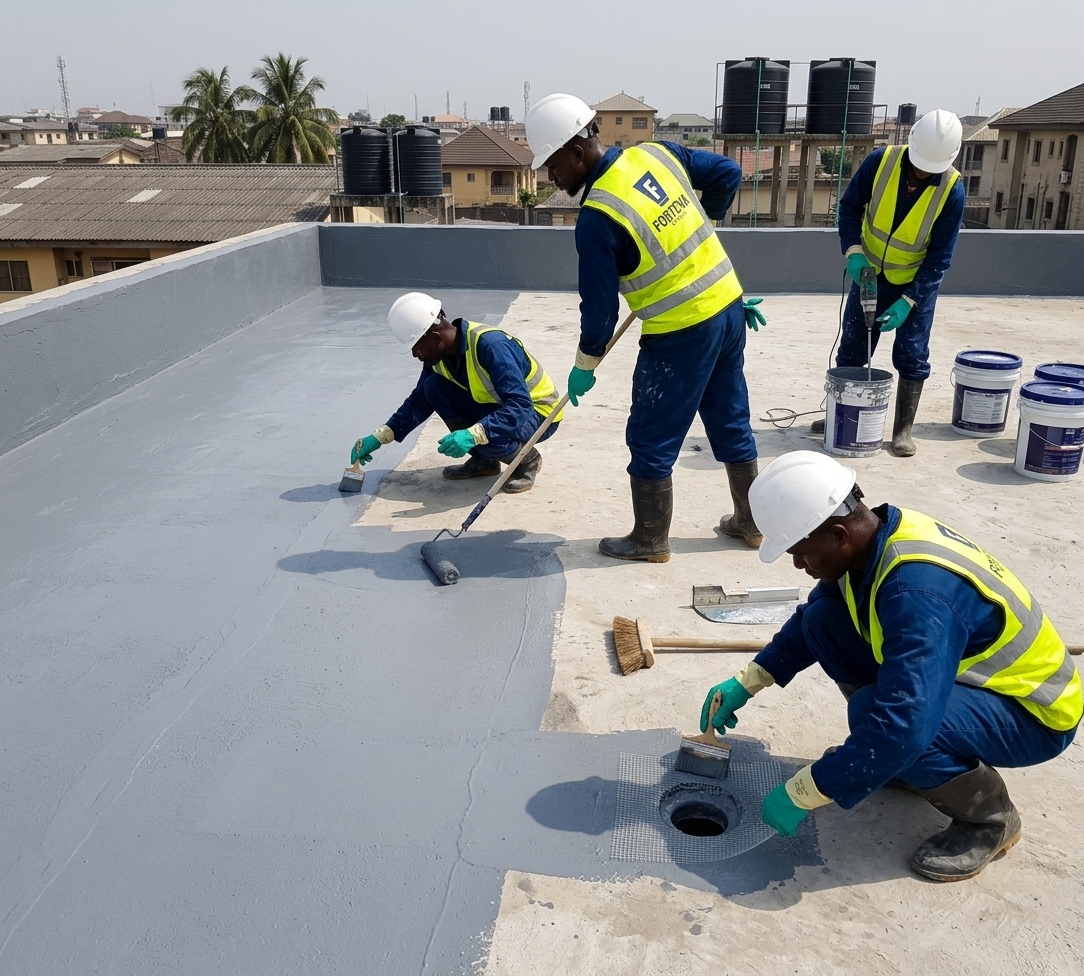
We waterproof roofs, wet areas, basements and tanks for estates, factories, hotels and hospitals across Lagos and Ogun State, working directly as main contractor from the free site inspection to the 24-hour flood test at handover. Our office is at 2 Alh Hafusat Abdulazeez Street, Ogidan, Ajah, Lagos.
How we run a waterproofing job
- Site inspection. Free. We assess the roof, basement, tank or wet area to be waterproofed.
- Design and quotation. You receive a detailed quotation, with a technical drawing if you want one.
- Materials to spec. We procure the systems named in the quotation, and install those.
- Milestone updates. Photos and video by email at each stage, so you can follow the work without visiting the site.
- Test. Flat roofs and wet areas are flooded and the water held for 24 hours while the space below is checked for leaks, and we go through the result with you before handover. Walls and other vertical surfaces get a water spray test instead.
- Cover. 6 months of free maintenance and 6 months of free defect repair, written into the contract.
Roofs, basements, tanks and wet areas
We work in four places:
- Flat roofs. Membranes or coatings, flood-tested as in step 5.
- Wet areas. Bathrooms, toilets, kitchens, plant rooms and balconies, flood-tested the same way.
- Basements. Besides membranes and coatings, basements can take three other systems: integral crystalline waterproofing, which forms crystals inside the concrete that block water; bentonite clay sheets, which swell when wet and seal the wall; and epoxy-cement mortars. The system is chosen at the site assessment.
- Tanks. Where we treat a tank depends on where it sits:
- Underground tanks are treated inside and outside. The outside keeps groundwater, dirt and contaminants from pushing in. The inside holds the water in and stops it leaking into the structure.
- Overhead and above-ground tanks are always treated inside, to hold the water and stop leaks through the structure. Treating the outside is optional, and protects it from sun and weather.
We waterproof external walls only where they meet a roof or a basement, not as a job on their own.
Roof leak repair in Lagos
If your roof already leaks, the job starts the same way as a new one: a site assessment, then design and a quotation. To find where the water is getting in, we inspect the roof by eye, trace the leak with an electronic detector that follows the path water makes through the membrane, and run dye and water-pressure tests. A repaired roof gets the same flood test and the same cover as a new one.
Membranes and coatings we install
A membrane is a continuous rubbery sheet or liquid layer that works like a raincoat for the building. A coating is a liquid barrier painted, rolled or sprayed onto a surface to stop water soaking in.
| Membrane | Suits | Avoid on | Typical use |
|---|---|---|---|
| Bituminous: torch-on (melted on with a flame) or self-adhered (peel and stick) | Concrete, masonry and brickwork; flat, simple surfaces | Polystyrene insulation, wood and plywood (torch-on is a fire risk), flexible plastics | Basement outer walls, the slab over a basement car park, flat concrete roofs |
| Liquid-applied (polyurethane, acrylic or bitumen) | Complex concrete shapes, corrugated metal, surfaces with many pipes or tight corners | Wet concrete (it blisters), dirty or dusty surfaces | Balconies, bathrooms, complex roofs, the joints where a roof meets a wall or pipe |
| PVC (a plastic sheet) | Insulated flat roofs, metal decks, smooth concrete slabs, steel tank interiors | Asphalt and old bituminous coatings, unless separated, because they soften PVC | Commercial flat roofs, large water reservoirs |
| EPDM (a synthetic rubber sheet) | Large open flat surfaces, timber and plywood decks, smooth concrete slabs | Oily or greasy surfaces, anything exposed to petroleum, sharp stones | Residential flat roofs |
The three coatings behave differently:
- Cementitious. Cement-based, so it soaks into the pores of concrete, stone and brick and cures as part of the wall. It suits surfaces that stay wet all the time. It is rigid, so it cracks over wood or thin sheet metal that flexes.
- Polyurethane. Cures into a tough, rubber-like layer that stretches with heat and cold and takes foot and vehicle traffic. It bonds to concrete and primed metal. Damp concrete makes it blister, so the surface must be dry when it goes on.
- Acrylic. Water-based and stable in sunlight. It suits walls and sloped surfaces where rain runs off quickly. It is not made to sit under water: if water ponds on it for days, it softens and washes off.
The thickness follows the surface:
- 1mm to 2mm: walls, metal sheeting and tight, complex shapes. A thin liquid layer stays elastic, lets moisture vapour out and does not sag as it goes on.
- 3mm to 4mm: roofs and general structural slabs. Enough body to span joints in the concrete that move, and to take foot traffic and slow-draining rain.
- 5mm: basements, foundations and heavily loaded structures. It stands up to the stones and soil packed against a basement wall, chemicals in the soil and high groundwater.
What your quotation specifies
Your quotation states four things for your surface:
- Type: the system, from the membranes, coatings and basement systems above.
- Thickness: 1mm, 2mm, 3mm, 4mm or 5mm.
- Application: brush, roller or spray.
- Finish: smooth, textured or anti-slip.
The material in the quotation is the material we install, so those four lines are what you check the finished work against. We do not supply material samples for waterproofing; the written specification takes their place. Payment milestones are agreed in writing.
For a main contractor bringing us in as waterproofing specialist, those four lines are the specification we deliver to in front of your client. For a procurement team, the same quotation is the document you file to show what was specified.
Where we work
FortevaWorks takes jobs across Lagos and in Ogun State, including Agbara, Ota, Igbesa and Sagamu, and in Abuja, Port Harcourt, Ibadan and Kano.
Ask for a waterproofing quotation
Tell us the surface (roof, basement, tank or wet area), its size in square metres and its current condition, using the enquiry form below. We reply within the hour. Our roof waterproofing cost guide explains what moves the cost of a roof job.
Office hours are 8:00am–5:00pm Monday to Friday and 8:00am–12:00pm on Saturday. Call or WhatsApp +234 8028347545, or email enquiries@fortevaworks.com.