
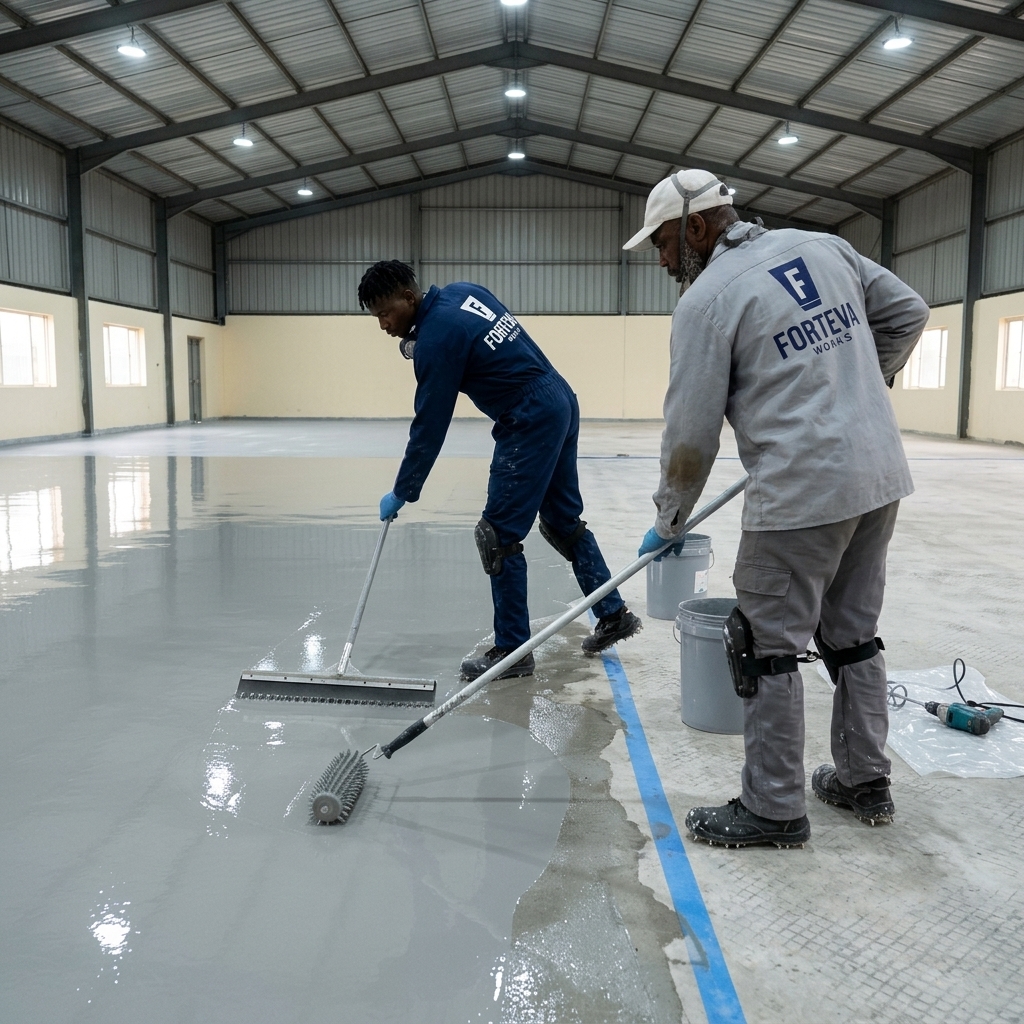
An epoxy floor suits an enclosed factory or warehouse slab in Lagos or Ogun State that carries forklifts, oils and alkaline cleaners. It is not the floor for outdoor areas.
What an epoxy floor does on a factory slab
An epoxy floor is a resin coating applied in layers over concrete, which cures into a surface bonded to the slab. A beverage factory in Agbara, Ogun State, needed its 2,000 m² floor to stand up to heavy machinery and foot traffic, and chose epoxy.
That floor is one of more than 50 epoxy floors FortevaWorks has worked on for factories in Ogun State.
With upkeep suited to its traffic, an epoxy floor has a lifespan of 10 years or more. That is the expected life of the floor, separate from the 6 months of cover written into the contract.
Chemical resistance depends on the resin type and the chemical. Fully cured epoxy resists oils and alkaline cleaners well and diluted acids moderately. It does not stand up to strong solvents or concentrated acids, so tell us what is spilled or washed on your floor at the site inspection.
How often the floor needs cleaning or recoating depends on its foot traffic, the machinery that runs on it, such as forklifts, and the chemicals it meets. We check the floor during the 6 months of free servicing after handover.
Choosing resin, thickness and finish for industrial flooring in Lagos
You choose four things in the quotation: the resin type, the thickness, the finish and the colour.
Resin type. We install solvent-free, solvent-based and water-based epoxy. The names describe what thins the resin before it is applied: a solvent, water, or neither.
For an enclosed production hall we recommend solvent-free (100% solids) epoxy: it gives off no solvent as it cures and stands up to heavy wear.
Epoxy is not used outside. An outdoor floor needs a resin that stays stable in UV light and flexes with the weather, such as polyaspartic or aliphatic polyurethane. We do not lay those floors, and we will tell you at the site inspection if part of your site needs one.
Thickness. We lay epoxy at 2mm, 3mm, 5mm or 10mm.
We choose the thickness by what runs on the floor:
- 2mm, medium duty: hand trolleys and light jacks. A self-smoothing, even surface.
- 3mm, heavy duty: daily electric forklift traffic. High wear resistance, and room for a textured finish.
- 5mm, high impact: heavy machinery and steel-wheeled equipment. Takes heavy tool drops without cracking.
- 10mm, ultra industrial: the heaviest loads and constant traffic. Stands up to steam cleaning and heavier chemical exposure.
Finish. The surface can be glossy, matte or anti-slip.
We specify the anti-slip texture by area:
- Wash-down areas such as food processing, breweries and chemical sump rooms: heavy to extra-heavy texture, specified to slip rating R12 to R13.
- Ramps and inclines such as forklift ramps, walkways and parking ramps: a heavy, sharp aggregate of medium-to-coarse quartz or aluminium oxide.
- Loading bays and receiving docks: medium texture, specified to slip rating R10 to R11.
Colour and decoration. Custom colours are available on request, matched to RAL or Pantone references. Metallic, flake and quartz finishes are also available.
Where it is made. Our epoxy materials are made by established manufacturers in China.
We share the product data sheets and delivery notes for the epoxy with you.
During the bid you can choose from samples and see photos of floors we have worked on.
Your concrete matters as much as the coating
Before the first layer of epoxy goes down, we clean the slab, grind it and prime it.
Cracks are filled and repaired, oil-soaked concrete is cleaned or ground back, old coatings are removed, and damp slabs are tested and dealt with before any epoxy goes down. Repair work found at the site inspection is listed in the quotation.
A new concrete slab takes epoxy once it has cured and a moisture test on the slab shows it is dry enough for the epoxy to bond.
Fitting the work around a running site
Large floors can be laid in sections so the rest of the site keeps working. The sections and their order are agreed at the site inspection.
We can also work at night or over weekends, so a factory keeps producing.
The floor is ready for foot traffic 3 days after the final coat.
What to send for a quotation
Send us your floor area in square metres, what the floor is used for and where the site is. If you can, add photos of the current slab. Our cost guide explains what moves the cost of an epoxy floor.
We take jobs across Lagos and Ogun State, including Agbara, Ota, Igbesa, Sagamu and the Lekki Free Trade Zone, and in Abuja, Port Harcourt and Kano. Our office is at 2 Alh Hafusat Abdulazeez Street, Ogidan, Ajah, Lagos.
Call or WhatsApp +234 8028347545, or email enquiries@fortevaworks.com. We reply to enquiries within the hour. Office hours are 8:00am to 5:00pm Monday to Friday and 8:00am to 12:00pm on Saturday.