
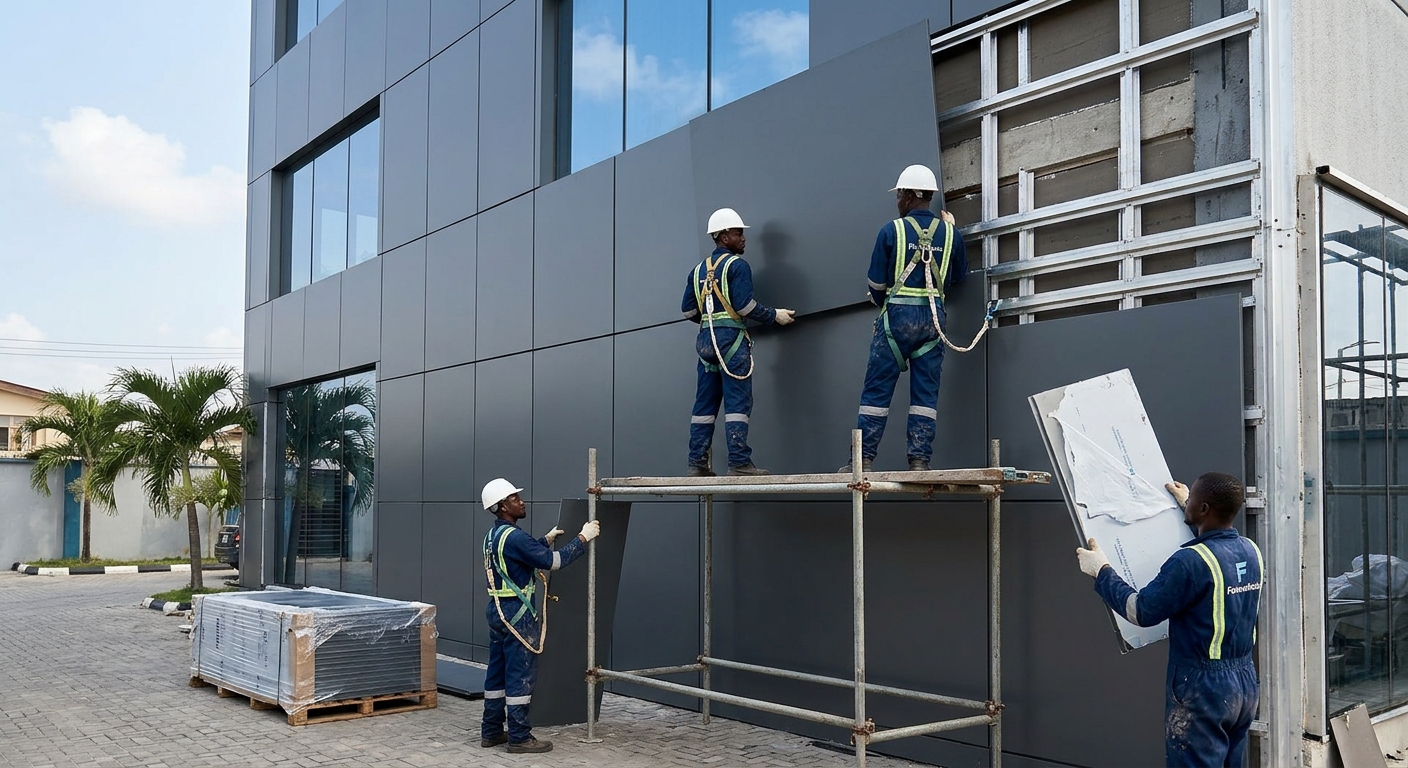
Which panel you need depends on the building. A high-rise, or a building where large numbers of people gather or sleep, calls for a Class A or Class B fire-rated panel. A signboard, a low-rise shop front or an internal wall can use standard ACP. The sections below set out the three panel types, the fire classes and how we fix them. FortevaWorks is the construction arm of FORTEVA, and also installs epoxy floors, waterproofing and water storage tanks.
Aluminium cladding in Nigeria: what goes on your walls
ACP cladding is exterior wall cladding made from aluminium composite panels. An aluminium composite panel is a sandwich: two thin aluminium skins permanently bonded to a core between them. The core is a thermoplastic polymer (plastic), inorganic non-combustible minerals, a metal structure, or a blend of these. The core is what sets the fire class.
We install three panel types:
- Standard ACP. For places where the fire risk to people is low: signage and billboards, internal wall cladding, low-rise retail fronts and housing covers for machinery. For other buildings we advise a fire-rated panel, and the building’s approving authority decides.
- Fire-rated ACP. Supplied in Class A, Class B or Class C, set out in the next section.
- PVDF-coated ACP. PVDF (polyvinylidene fluoride) is a fluoropolymer coating applied to the outer aluminium skin. It is an ultra-durable shield that protects the aluminium from environmental deterioration.
Panels come in 3mm, 4mm and 6mm thicknesses. 3mm suits light duty and signage. 4mm is the standard for building exteriors. 6mm suits heavy-duty and specialised engineering work.
The panel face can be matte, glossy, metallic or wood grain. Custom colours are available on request, including colours specified by a RAL or Pantone code.
Sample ACP panels are available to inspect during the bid.
Fire-rated ACP panels
Our fire-rated ACP panels are supplied in three classes: Class A, Class B and Class C. The classes refer to two fire test standards: ASTM E84 (North American) and EN 13501-1 (European). Class A matches Euroclass A2, limited combustibility.
- Class A: limited combustibility. We advise it for high-rise buildings. Available in 4mm and 6mm, with 0.50mm aluminium skins. There is no 3mm Class A panel, because a thin core cannot carry the mineral filler.
- Class B: fire-retardant. We advise Class A or Class B where large numbers of people gather or sleep. Available in 4mm and 6mm, with skins from 0.30mm to 0.50mm.
- Class C: standard combustible. For low-risk, low-rise and interior work in Lagos: single-storey shops on the mainland, billboards and signage in places like Ojota and Maryland and internal office partitions. Available in 3mm, 4mm and 6mm, and most common at 3mm, with skins from 0.12mm to 0.30mm.
How a cladding job runs
- Site assessment and consultation. We assess the walls to be clad. We check the fire class the building needs, how the sub-structure and fixings will carry wind load, how the joints will be sealed and drained, and where fire barriers are needed in the cavity at every floor.
- Design and selection of ACP panels. You choose the panel type, thickness, finish, colour and fire class, and that choice becomes the panel specification.
- Preparation of the building surface. Before any panel goes on, we check the wall for level and plumb, clean and degrease it, and mark out the cavity and the fixing grid.
- Installation of the panels. We use three fixing methods. The cassette system (rout and return) hides the fixings and suits high-rises and commercial fronts. Face fixing, by rivet or screw, leaves the fixings visible on the wall face. Structural bonding, with tape and adhesive, leaves a flat face with no visible holes and suits light-duty work.
- Water spray test. Every panel is checked for alignment and secure fixing, every sealant joint is inspected, and the joints are sprayed with water to confirm none gets behind the cladding. We run it with you before handover.
- Final inspection and handover. Six months of free maintenance and defect repair then start, written into the contract.
The timeline for your job is set in the quotation. We mobilise workers to the site when we receive the first advance payment.
For main contractors and procurement teams
Main contractors can bring us in as the cladding specialist on a larger build, installing the panels named in their specification. Milestones are agreed up front and reported by email with photos and video.
FortevaWorks trades as FORTEVA APEX WORKS LIMITED, registered with the CAC as RC 9883497 in September 2025. Each quotation states the panel specification, so a procurement team can file it and compare bids line by line.
Price
ACP cladding is quoted per job. Building height, panel grade, thickness, fire class, finish type and installation complexity move the cost, and so do the size of the project, the cost of materials and the location. The site inspection is free, and after it you receive a detailed quotation, with a technical drawing if you want one.
Where we work
Our office is at 2 Alh Hafusat Abdulazeez Street, Ogidan, Ajah, Lagos. We take cladding jobs across Lagos, including Lekki, Ajah and the Lekki Free Trade Zone, and in Ogun State towns including Agbara, Ota, Igbesa and Sagamu. Outside Lagos and Ogun, we take jobs in cities including Abuja, Port Harcourt, Ibadan, Kano, Enugu and Benin.
Call or WhatsApp +234 8028347545, or email enquiries@fortevaworks.com. We reply within the hour; the office is open 8:00am to 5:00pm Monday to Friday and 8:00am to 12:00pm on Saturday. You can also request a quotation.