
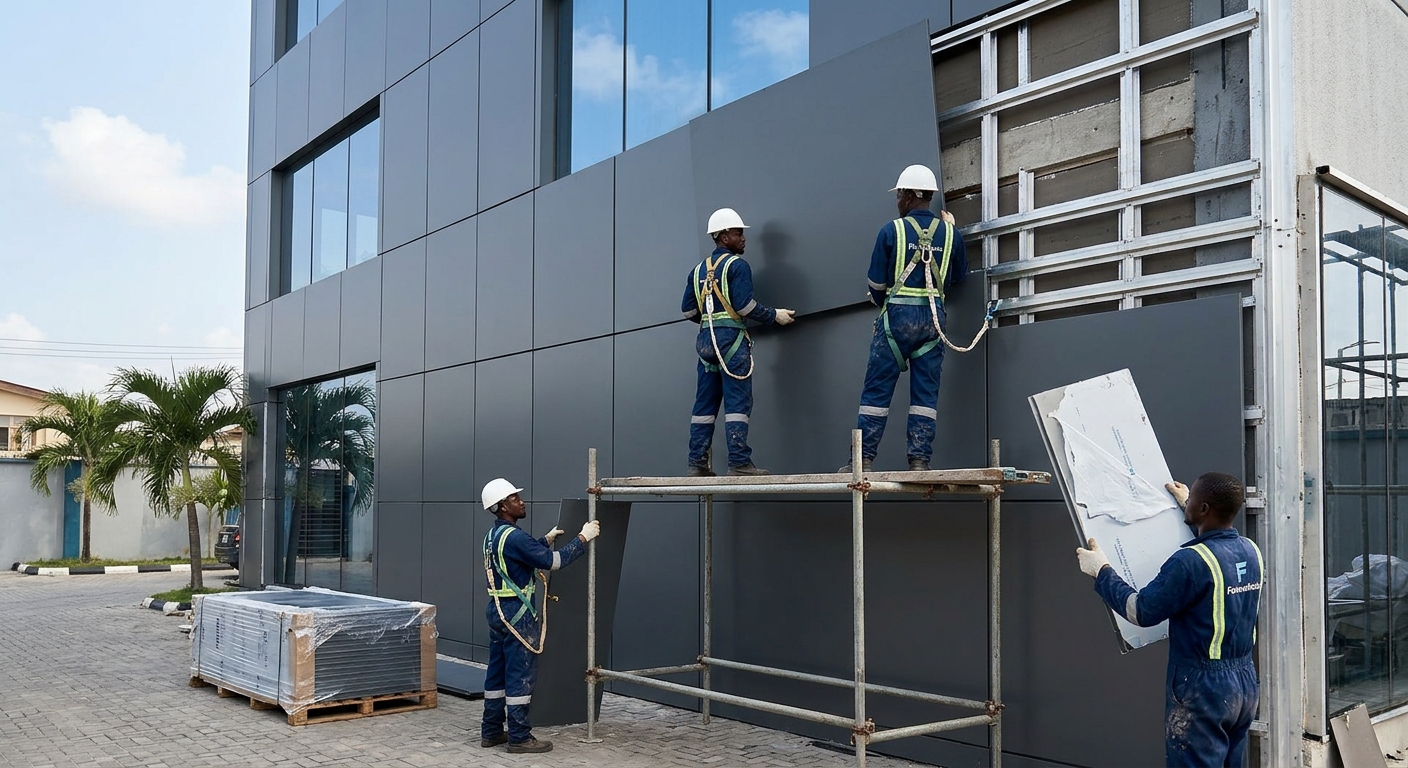
Building height
Height changes four things on a cladding job. Taller walls need scaffolding, a cradle or a boom lift to reach them. Higher walls take more wind, so the sub-structure and fixings are designed for that load. On a high-rise we advise Class A fire-rated panels, and high-rises usually take the cassette fixing system, which hides the fixings.
Panel grade: standard, fire-rated or PVDF-coated
Fire-rated panels, Class A and Class B, cost more than standard ACP. Thicker panels cost more than thinner ones, because 4mm and 6mm use more material than 3mm. A PVDF-coated face, an ultra-durable coating that protects the aluminium from the weather, costs more than a standard coating. The grade, thickness and fire class sit on one line of the panel specification in your quotation.
Finish type and colour
Metallic and wood-grain finishes, and custom RAL or Pantone colours, cost more than standard matte or glossy colours. If you already have a RAL or Pantone code, bring it to the design and selection step; otherwise you choose the finish and colour with us there.
Installation complexity
Complexity comes from the wall itself: the fixing method it needs (the cassette system, face fixing or structural bonding), how much preparation it needs before panels go on (checking it is level and plumb, cleaning and degreasing, marking out the fixing grid), and how easily the crew and equipment can reach it. Every job ends with a water spray test on the sealant joints, run with you before handover.
Wall area, materials and location
Wall area. On a cladding job, size is the wall area to be clad, in square metres. A larger wall area usually brings the figure per square metre down, because the fixed costs of a job, such as setting up access and the water spray test, are spread over more square metres. Our cladding calculator gives you the wall area before the inspection; it does not give a price. FortevaWorks worked on 3,000 m² of ACP cladding for a commercial client in Lekki, Lagos, completed in August 2026.
Materials. The panel grade, thickness, finish and colour set the materials line, and we supply the materials to the specification in the quotation.
Location. We take jobs across Lagos and Ogun State, including Lekki, Ajah, Agbara, Ota and Sagamu, and in cities such as Abuja, Port Harcourt, Kano and Enugu. A site further from Lagos adds the transport of panels, crew and equipment, which is priced in the quotation.
What our quotation commits to
The panel named in our quotation is the panel on your wall, with no swap for a cheaper one after signing. The quotation comes with a technical drawing if you want one, so you see the cladding on your building before work begins. We run the water spray test with you at handover, not on our own. The contract carries six months of free maintenance and six months of free defect repair.
Before the site inspection
Have four things ready when you book the free site inspection:
- The wall area. Use the cladding calculator to work out the square metres to be clad.
- The building’s address. A site further from Lagos adds transport to the quotation.
- Your panel preferences, if you have them. Grade, thickness, finish and any RAL or Pantone code.
- Whether you want a technical drawing. It comes with the detailed quotation if you ask for it.
At the inspection we look at the fire class we would advise for the building, how the sub-structure and fixings will carry wind load, how the joints will be sealed and drained, and where fire barriers go in the cavity at each floor. What we find there is what the quotation prices. The panel options and how every job runs are on our ACP cladding page.