
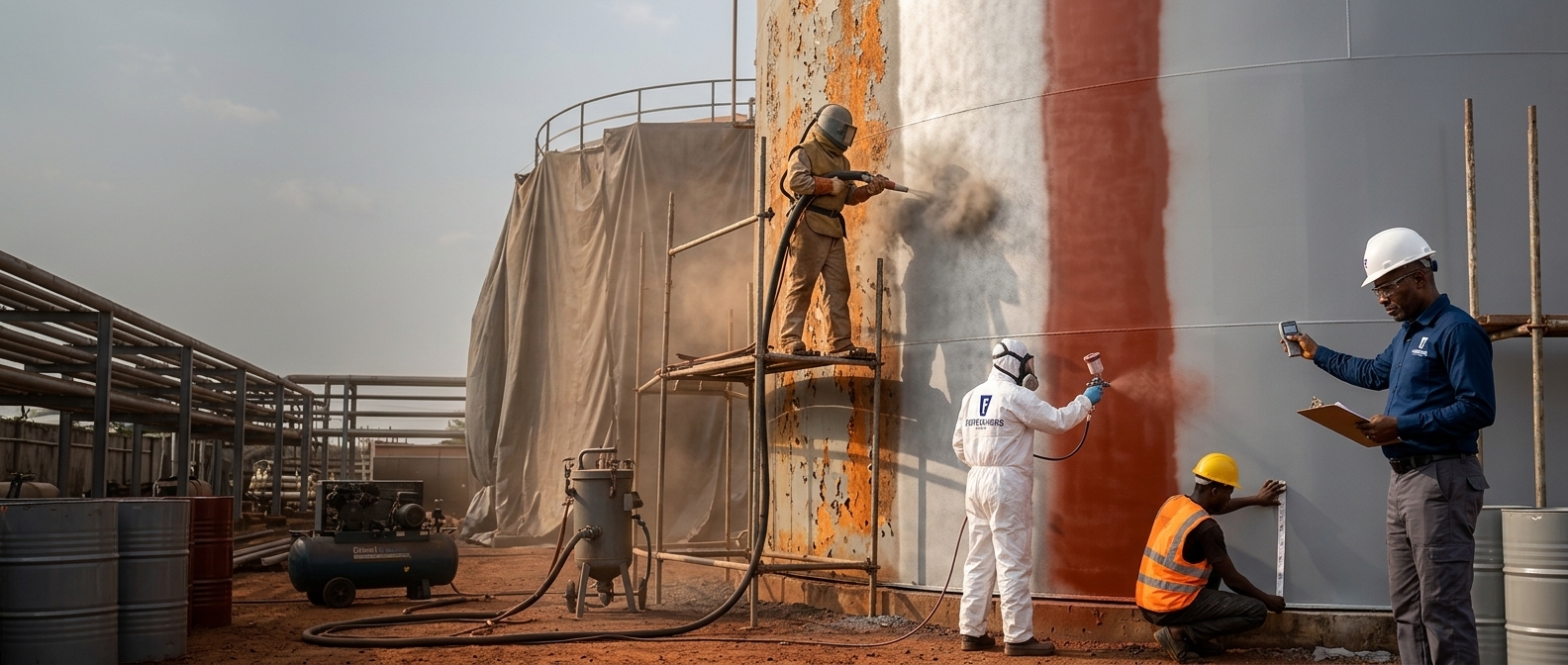
Industrial blasting and painting in Nigeria comes down to one question: can you prove the steel was cleaned and coated properly once the paint hides it? We blast and paint steel tanks inside and outside, steel structures such as warehouse frames, roof trusses and platforms, and pipework, including pipe racks in place. The work is done on your site, and every stage is measured and written into an inspection record your representative signs.
How we run a blasting and painting job
- Assessment. At the free site inspection we decide whether the old coating comes off to bare steel or, if an adhesion test shows it is still firmly bonded, stays and is painted over.
- Blasting. Sand, steel grit or glass beads strip rust, mill scale (the blue-grey skin left on new steel at the mill) and old paint, to the preparation grade below.
- Checking the blasted steel. We measure the surface profile and record the grade achieved.
- Coating. Before each coat we measure humidity and the dew point. The first coat goes on the same day as blasting, then the remaining coats of the system.
- Checking the coating. Each coat’s thickness is measured with a gauge, and immersion coatings are checked with a holiday detector, which finds pinholes and gaps.
- Handover. We walk the finished steel with you and hand over the inspection record.
You receive photos and video by email at each stage.
Surface preparation
Blasting, often called sandblasting, drives an abrasive at the steel with compressed air. The result is specified as a preparation grade: a written standard for how clean the blasted steel must be.
- We work to ISO 8501-1: Sa 2½ (near-white blasted steel) for inland and coastal steel, and Sa 3 (blasted to bare, even metal) for immersion and chemical service.
- We blast dry, or wet (with water mixed into the abrasive to keep the dust down), as the site allows.
- We aim for a surface profile, the roughness the coating grips, of 50 to 75µm, measured with a profile gauge or replica tape (a film pressed onto the steel that takes an impression of it).
- Where open blasting is not allowed, we clean with power tools to grade St 3, a thorough power-tool clean to bright metal.
Coating systems by environment
A coating system is the set of coats applied one over another, each at a set thickness. The right one depends on what the steel faces once it is back in service.
| Environment | What the steel faces | Coating system we apply |
|---|---|---|
| Inland | Sun and rain away from the sea, e.g. a warehouse frame in Abuja or Kano | Epoxy primer at 75µm, then a polyurethane topcoat at 50µm |
| Coastal | Salt in the air near the sea and creeks, e.g. a plant in Lagos, Onne or Calabar | Zinc-rich epoxy primer (loaded with zinc dust that protects the steel) at 60µm, epoxy intermediate at 120µm, polyurethane topcoat at 60µm |
| Immersion | Liquid standing against the coating, e.g. the inside of a tank | 2 to 3 coats of high-build epoxy (a thick epoxy laid in fewer coats), 300 to 400µm in total |
| Chemical | Splash or contact with chemicals, e.g. a process area in a factory | 2 coats of epoxy novolac (a chemical-resistant epoxy), about 300µm in total, resisting acids and alkalis |
Your quotation names the abrasive and the coatings, and the material in the quotation is the material we install. Finishes come smooth or textured, in custom colours on request, and fire-resistant and UV-resistant coatings are available.
Application and site conditions
- Full coats go on by airless spray, which atomises the paint under pressure without compressed air. Edges, welds and touch-up are done by brush or roller.
- We coat only when relative humidity is at or below 85% and the steel is at least 3°C above the dew point, the temperature at which moisture condenses on it.
- Blasted steel gets its first coat the same day.
- In the rainy season we work in dry windows, under cover or in enclosures where needed, on a programme agreed in the quotation.
Inspection and records
We inspect with a dry-film thickness gauge, a surface profile gauge, a humidity and dew-point meter, and a holiday detector for immersion coatings. A daily inspection record is kept and signed by our supervisor and your representative. It states:
- the preparation grade achieved
- thickness readings by area
- the coating batch numbers
- the conditions measured before each coat
Before handover, every painted surface is also checked for adhesion, coverage and finish, and the inspection can include a pull-off test, which measures how firmly the coating is bonded to the steel.
Safety and containment on site
- Blasting crews wear blasting helmets with an air supply; painters wear respirators. Everyone wears coveralls, gloves and ear protection.
- Dust and overspray are contained with sheeting or enclosures. Spent abrasive and old paint are collected and taken off site.
- Old coatings that may contain lead are tested first, then removed inside containment.
- On oil and gas and other live facilities, blasting and spraying are screened off from running plant, staff and stock. We work under your permit-to-work (the site’s written authorisation for each task) and hot-work permits, after your site induction.
Documents at handover
- The inspection record, signed daily by our supervisor and your representative.
- Milestone photos and video, already in your email.
- The contract, with 6 months of free routine servicing, cleaning and checks, and 6 months of free repair of defects. It covers defects in materials and workmanship, and not damage caused by misuse, neglect or natural disasters.
For a procurement team, these are the documents you file to show what was delivered.
Where we work and who it is for
We offer blasting and painting in every one of our service areas, from our office at 2 Alh Hafusat Abdulazeez Street, Ogidan, Ajah, Lagos. Blasting equipment and abrasive are trucked to the site from Lagos. The work is aimed at oil and gas facilities (tank farms and pipe racks), factories (steel structures and roof trusses) and port sites such as Onne and the Lekki Free Trade Zone. Main contractors can bring us in as a specialist on their sites.
FRP/GRP linings for tanks are covered on our fibreglass lining page.
What decides the cost
Four things move the cost of a blasting and painting job:
- Surface preparation. How much rust, old paint and contamination has to come off before the first coat.
- Coatings and finish. Which coatings go on, and whether the finish is smooth or textured.
- Size and complexity. How much steel there is, and how complex its shape is.
- Site access. How easily the crew, blasting equipment and abrasive reach the steel.
The figure comes in a detailed quotation after a free site inspection, with a technical drawing if you want one. We mobilise workers to the site when we receive the first advance payment.
A checklist for choosing a blasting and painting contractor
Ask every contractor bidding for your job:
- Which preparation grade, from which standard? Ours is ISO 8501-1, Sa 2½ or Sa 3, and the grade achieved is recorded.
- Which coating system, coat by coat? Ours is set out in the table above for each environment.
- Will thickness be measured and handed over? Ours is gauged and recorded by area.
- Who signs off the blasted steel before the first coat? Your representative signs our daily inspection record.
- How will dust, spent abrasive and overspray be contained? Ours are sheeted or enclosed, and the waste is taken off site.
- What does the warranty cover, and for how long, in writing? Ours is 6 months of free maintenance and 6 months of free defect repair.
Ask for a blasting and painting quotation
Tell us what needs coating, its location, its approximate surface area in square metres and the condition of any existing paint, using the enquiry form below. We reply within the hour. Office hours are 8:00am–5:00pm Monday to Friday and 8:00am–12:00pm on Saturday. Call or WhatsApp +234 8028347545, or email enquiries@fortevaworks.com.