
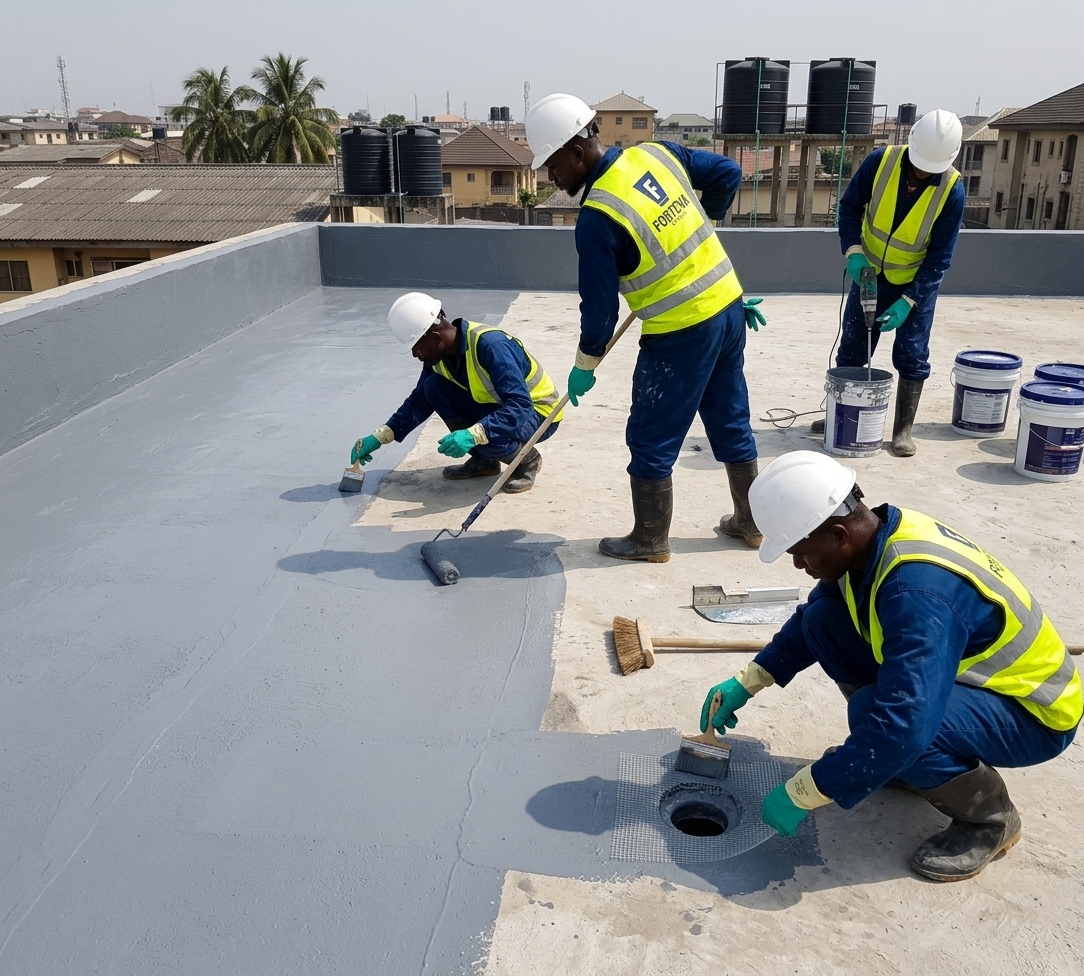
FortevaWorks quotes every roof after a free site inspection, because what changes the job is found on the roof itself. Each section below explains one of the four things above and what to look for in your quotation. The systems, the flood test and how a job runs are on our waterproofing page.
Surface condition and old layers
At the inspection we check the roof for cracks in the slab or screed, ponding (low spots where water sits after rain), loose or broken screed, and damp in the slab. If the roof leaks now, we trace where the water gets in by eye, with an electronic leak detector that follows the path water makes through the membrane, and with dye and water-pressure tests.
Each of these adds work before the new layer can go on, and so does an old layer that has failed, because it has to be stripped. A sound old layer is repaired and laid over instead. Check that your quotation says which layers on your roof are stripped and which are laid over.
Membrane or coating, and thickness
We install four membranes (bituminous, liquid-applied, PVC and EPDM) and three coatings (cementitious, polyurethane and acrylic), applied by brush, roller or spray, in a smooth, textured or anti-slip finish.
- Flat concrete roof: bituminous, PVC, EPDM or a liquid-applied membrane, usually at 3mm to 4mm, enough body to span joints in the concrete that move and to take foot traffic and slow-draining rain. Acrylic is not used where water ponds, because it softens and washes off.
- Metal roof: a liquid-applied membrane on corrugated metal, or PVC on a metal deck. Thin metal sheeting takes a 1mm to 2mm layer that stays elastic and does not sag as it goes on.
Where a sound old bituminous layer is laid over with PVC, the two are kept separate, because bitumen softens PVC. The system, thickness, application method and finish you agree are the four lines to check the finished roof against.
Roof area and location
The roof area is measured at the free site inspection, so the quotation is built on your roof’s measurements in square metres rather than an estimate. We take roof jobs in every one of our service areas, and the location of the building is one of the things the quotation prices.
Preparation before the new layer
Depending on what the inspection finds, preparation covers:
- cleaning the roof surface
- repairing cracks in the slab or screed
- repairing loose screed, or re-levelling it to clear ponding
- drying the slab, then a moisture test, because liquid-applied membranes and polyurethane blister on damp concrete
- priming, so the new layer bonds to the roof
In the rainy season, the work goes ahead in dry windows, under cover or in enclosures where needed, on a programme agreed in the quotation. Check that your quotation lists the preparation your roof needs.
Before the site inspection
Note what the roof is made of, its size in square metres if you know it, and where it leaks now, then book your free site inspection on the enquiry form.