
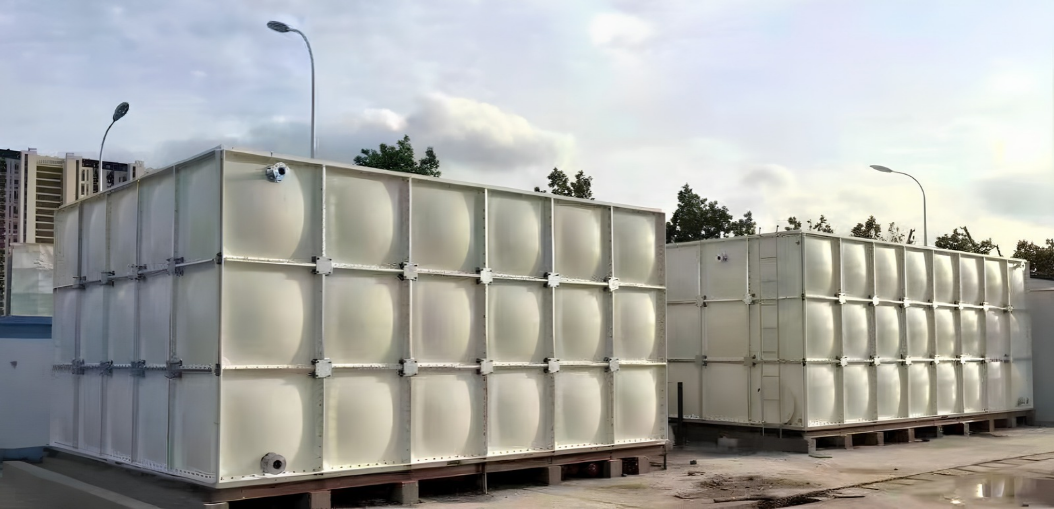
This guide is for estate managers, developers and facility managers in Lagos, Ogun and other states who are planning an FRP/GRP sectional tank, from 5,000 litres with no fixed maximum. FRP is fibre-reinforced plastic and GRP is glass-reinforced plastic; both name the same kind of panel tank. Each section below gives the detail behind one factor and what to check in a tank quotation. For the tank itself, see FRP/GRP water tanks; for how a tank job runs, see our water storage systems service page.
Capacity
A sectional tank is bolted together on site from flat panels, so a complete tank needs several of them. Common capacities are 5,000, 10,000, 20,000, 30,000, 50,000 and 100,000 litres, there is no fixed maximum, and custom sizes are available on request. Check that each quotation you compare states the capacity in litres, so the bids describe the same tank.
To size the tank before the inspection, work it out by hand: storage needed = people served × litres per person per day × days of storage. The planning value for urban supply is 120 litres per person per day, from the Nigerian Water Supply and Sanitation Policy. Days of storage are set at the inspection, from how reliable your borehole, mains and power supply are.
Tank height
Standard heights are 1.0, 1.5, 2.0, 2.5 and 4.0 metres, with custom heights on request. Height and footprint work together: a 5,000-litre tank stands 1.5m high on a 2m × 2m footprint, and a 50,000-litre tank 2.5m high on 6m × 4m. A taller tank also needs thicker panels at the bottom, where the water presses harder. The footprint for each common size is on our water storage systems page. Check that each quotation states the tank’s height as well as its capacity.
Site access
The largest panel is 2m × 2m, so the route from your gate to the tank position has to take a panel of that size. Walk that route before the inspection and note gates, stairs and tight corners; we check it, and the space around the base, on the day.
Stand height: cement base, stanchion or rooftop
FortevaWorks can build the cement base or the metal stanchion as part of the job, or you can have it ready before we arrive to install. The stanchion is built to whatever height your site needs, confirmed at the inspection. A tank can also go on a rooftop once a structural engineer has signed off the roof, and FortevaWorks arranges that sign-off.
Whoever builds the base, the tank is filled to full capacity for the 24-hour fill test and then checked to be level on it. You supply the water for that test, so plan for a full tank’s worth.
Installation complexity
Three things make a tank installation more complex. Tight site access, such as a narrow gate or road, means the panels are carried in by hand rather than offloaded beside the base. A large capacity means more panels, a bigger base and more people on site. Extending an existing tank means opening it up, adding panels and resealing it, and its cost is set after the site visit, once we have seen the tank and what it stands on.
Two options also change the specification: a UV-resistant coating for a tank that stands outdoors, and temperature-resistant options. Check that each option you ask for is written into the quotation by name.
Location
Location is one of the three things that move the cost of every job we quote, alongside the size of the project and the cost of materials. The panels are delivered to your site, wherever it is in our service areas, from Lagos and Ogun to Abuja, Port Harcourt and Kano.
What “supply” covers
Supply covers all the materials purchased for the job. The specification in your quotation is the material we install, with no swap for a cheaper panel or resin. Sample FRP/GRP panels are available during the bid, so you can check the panel and its food-grade resin before you sign.
What to get in writing
Beyond the quotation checklist below, check that every tank bid states:
- Where the tank stands. Cement base, stanchion or rooftop; whether the bidder builds it, and to what height, or expects you to have it ready.
- Fittings. Each fitting the tank comes with, listed by name. Ours come with seven as standard on every tank: a ballcock assembly, an inlet, an outlet valve, an overflow, a vent, a manhole cover and a ladder.
Before the site inspection
Have these ready for the free site inspection:
- The number of people the tank serves, or the capacity you need in litres.
- The site address and state.
- Cement base, stanchion or rooftop, the height you need, and whether you want us to build it.
- For an extension, the current capacity of the tank and the capacity you need.
- Whether the tank will stand outdoors, for the UV-resistant coating.
- Where the water for the 24-hour fill test will come from.
Book the inspection through the enquiry form.