
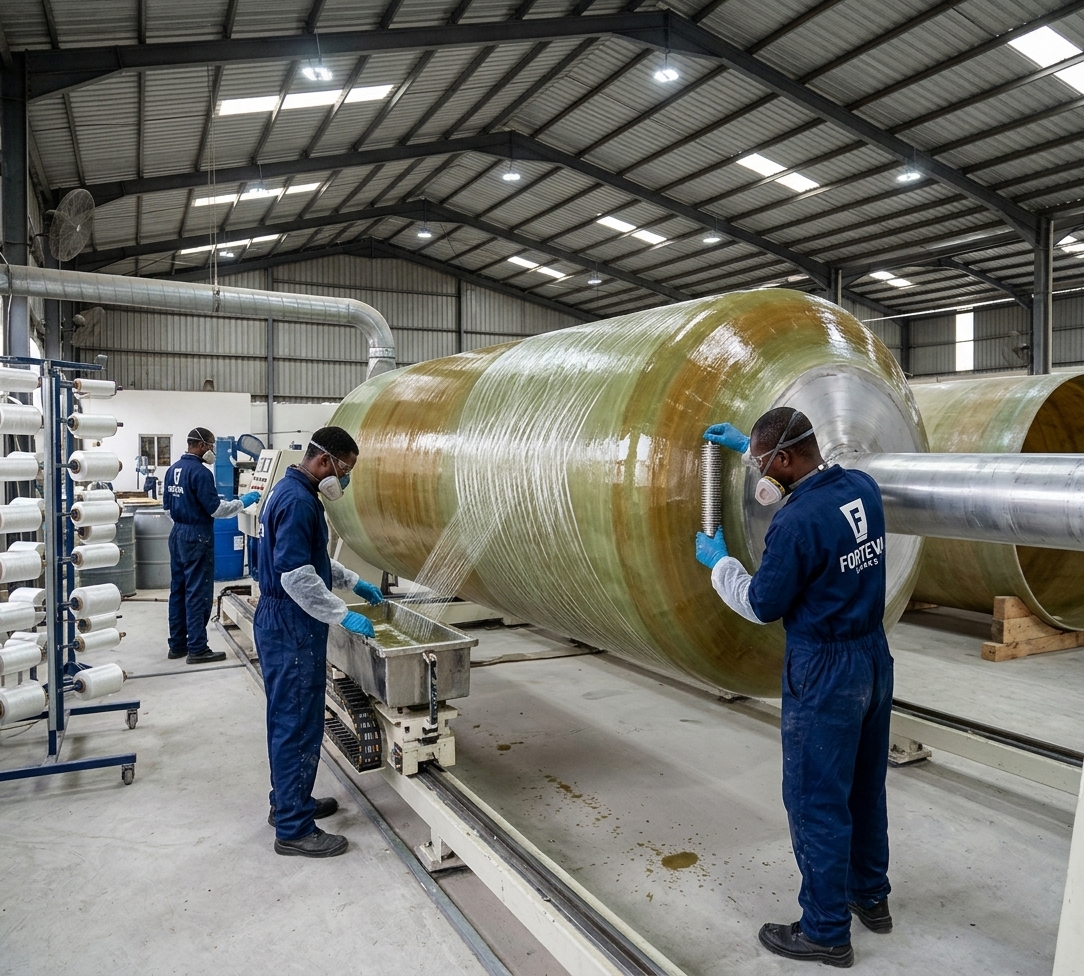
We fabricate FRP/GRP water storage tanks, chemical storage tanks and components, in any size, in our Lagos workshop. FRP stands for fibre-reinforced plastic and GRP for glass-reinforced plastic: a plastic resin strengthened with glass fibre, which buyers also call fibreglass. Tenders call it fiberglass fabrication or GRP fabrication. Whichever name yours uses, FRP/GRP composite fabrication in Nigeria is worth comparing on five points: the resin, the laminate, the moulding method, the checks before handover and the delivery.
What we fabricate
We fabricate three kinds of FRP/GRP part, each in the size your site needs:
- Water storage tanks, in food-grade resin.
- Chemical storage tanks.
- Components, such as nozzles, elbows and manways.
The FRP/GRP sectional tanks on our water storage systems page are a separate line. Their SMC (sheet moulding compound) GRP panels, 2m × 2m and 1m × 1m, come from our manufacturing partner, and we supply and install them. For a complete tank, see FRP water tanks. To line an existing concrete tank with FRP/GRP, see fibreglass lining.
Resin choices and where each suits
The resin named in your quotation is the resin we use. We do not swap it for a cheaper one after you sign.
- Isophthalic polyester, the everyday polyester resin: general use and water.
- Vinyl ester, a tougher resin that stands up to chemical attack: chemicals and acids.
- Epoxy: parts that need high strength.
- Food-grade resin: water storage, so the tank won’t taint what it stores.
Options by service condition
These options are chosen by where the part will work, on top of the resin:
- Outdoor sun: a UV-resistant coating.
- Fire risk: a fire-resistant coating.
Laminate, finish and colour
The laminate is the wall of the part: layers of resin and glass reinforcement built up to a set thickness. Whatever laminate build the quotation names is the build in the part.
We reinforce with chopped strand mat, a mat of short glass strands laid at random, and woven roving, glass fibre woven into a heavy cloth. Laminates run from 2mm to 6mm thick, and thicker where your part needs it. Extra reinforcement layers can be added to make a part stronger.
The surface can be smooth, textured or anti-slip, and the part can be made in a custom colour on request.
To check the laminate before you sign, ask us for a sample panel or a test coupon, a small piece of laminate made for testing.
How a part is made
Every fabrication order runs in seven steps:
- Design: FortevaWorks designs the part from measurements taken at the free site inspection, so you do not need a drawing of your own.
- Material selection and procurement: the resin, reinforcement and coatings named in the quotation.
- Mould creation and preparation: we build a custom mould from measurements taken on your site, and keep the mould after the order.
- Layup: FRP/GRP layers and resin are built up in the mould.
- Curing and finishing: the resin hardens, then the surface finish and colour are completed.
- Quality control and inspection of dimensions, surface finish and structural integrity.
- Delivery and handover of the finished part to you.
We mould parts by four methods: spray-up, filament winding, resin infusion and hand layup. Hand layup suits fittings and joints, such as nozzles, elbows and manways.
You receive photos and video by email at each milestone, so you can follow a part from mould to delivery without coming to the Lagos workshop.
Quality checks before handover
Every part is inspected for three things before handover: dimensional accuracy, surface finish and structural integrity. We check by visual inspection and dimensional measurements.
Each test follows the resin and material manufacturers’ specifications.
Delivery and installation: where we work
Parts are made in our Lagos workshop. We arrange the transport from the workshop and offload the part at your site. If you want it installed, ask, and we add installation to the order.
Our office is at 2 Alh Hafusat Abdulazeez Street, Ogidan, Ajah, Lagos. The places we take jobs include:
- Lagos: Lekki Free Trade Zone and the rest of the state.
- Ogun: Agbara, Ota, Igbesa, Sagamu, Abeokuta.
- South-West: Ibadan, Akure, Ondo, Ekiti.
- South-South and South-East: Port Harcourt, Trans-Amadi, Eleme, Onne, Warri, Asaba, Benin, Calabar, Uyo, Bayelsa, Enugu, Onitsha, Nnewi, Aba, Owerri.
- North: Abuja, Kaduna, Kano, Katsina, Sokoto, Jos, Minna, Bauchi, Adamawa, Taraba, Nasarawa, Kogi, Kwara.
We mobilise workers to site when we receive the first advance payment. The quotation states the timeline for your order.
Cover after handover
Every fabricated part comes with 6 months of free routine servicing, cleaning and checks, and 6 months of free repair of defects. Both are written into the contract. The cover is for defects in materials and workmanship; it does not cover damage from misuse, neglect or natural disasters.
What decides the cost
Four things move the cost of a fabrication order:
- the size and complexity of the part
- the materials and finishes chosen
- how much is custom: shape, size and colour
- where the part is delivered or installed
Every quotation starts with a free site inspection. You then receive a detailed quotation, with a technical drawing if you want one.
To start, send us the part you need, its size, a drawing if you have one, what it will hold or touch, and the state it is going to. Use the enquiry form below.
A checklist for choosing a fabricator
Ask any FRP/GRP fabricator in Nigeria these questions before you sign, and ask us the same:
- Which resin, by name, and why it suits what the part will hold or touch. It should be written in the quotation.
- Which reinforcement and what laminate thickness. Also in the quotation, so the build can be checked against it. Ours is chopped strand mat and woven roving, from 2mm to 6mm or thicker.
- Can I see a sample before signing? Ask us for a sample panel or a test coupon.
- What inspection does the part pass before handover, and to what specification? Ours covers dimensions, surface finish and structural integrity, to the resin and material manufacturers’ specifications.
- Will I see the work as it happens? We send photos and video by email at each milestone.
- What is the cover after delivery, and is it in the contract? Ours is 6 months of free maintenance and 6 months of free defect repair, with the exclusions written in.
Industries we serve
What each buyer orders from this service:
- Factories and food and beverage plants: water and chemical storage tanks.
- Oil and gas facilities: chemical tanks and components.
If the steel the part bolts to also needs protecting, see industrial blasting and painting.