
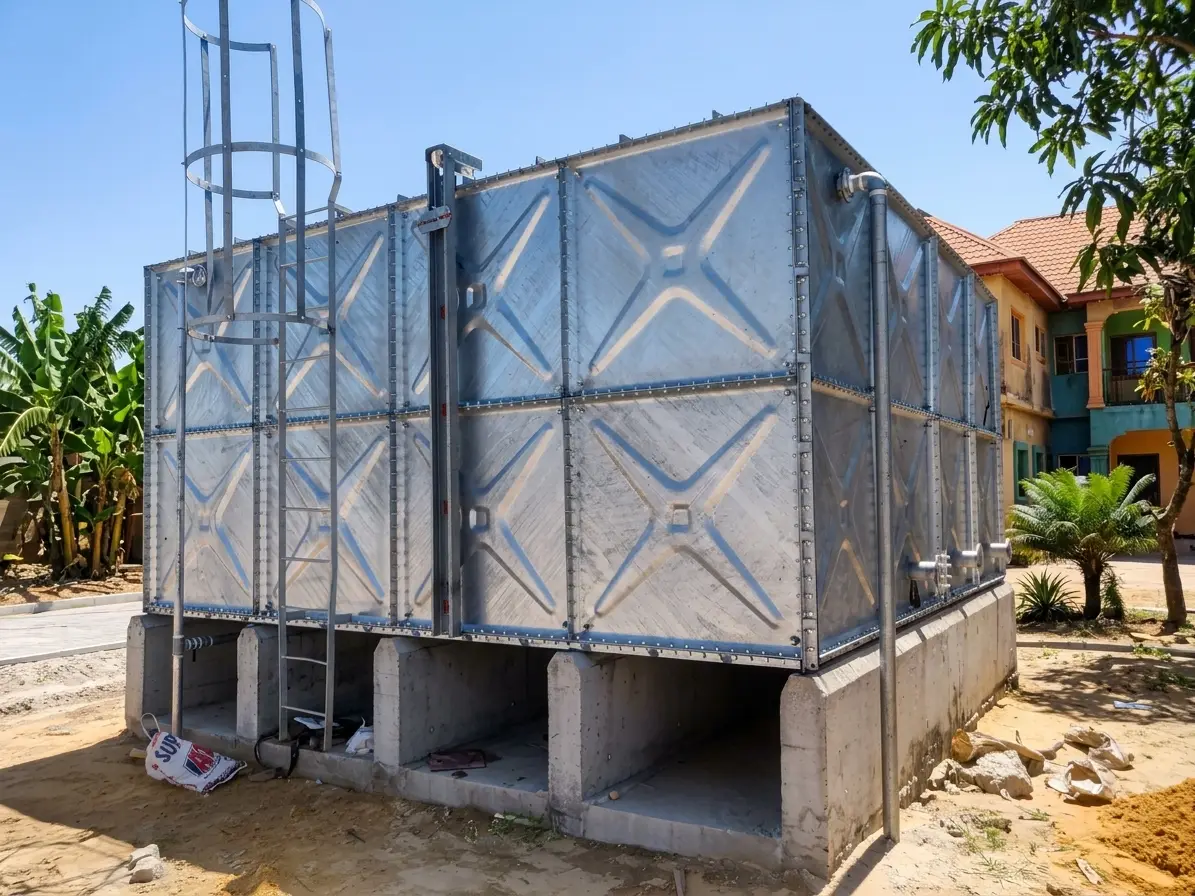
Both tank types are sectional: panels arrive on site and are coupled together where the tank will stand. FortevaWorks supplies, installs and maintains both, the FRP/GRP water tank and the Braithwaite tank. So the Braithwaite vs FRP tank choice rests on the panel material, not on how the tank goes up.
“Braithwaite” is the name widely used in Nigeria for a pressed steel sectional tank. We use it for the tank type, never for one maker.
What each tank is built from
An FRP/GRP tank is built from SMC GRP panels. SMC stands for sheet moulding compound; GRP stands for glass-reinforced plastic, the same material as FRP. The panels come in three sizes, 2m × 2m, 1m × 1m and 1m × 0.5m, and are joined with galvanised steel bolts. Established manufacturers in China, South Korea and Malaysia make them with food-grade resin.
A Braithwaite tank is built from galvanised steel panels. Galvanising is the coating on the steel that keeps rust off it. Both tanks come in any capacity your site needs, built up from panels; our FRP/GRP tanks start at 5,000 litres.
FRP vs Braithwaite tank in Nigeria: lifespan and rust
With proper maintenance, our FRP/GRP tanks have a typical lifespan of about 40 to 50 years. GRP panels are corrosion-resistant, so there is no coating on them to wear through.
A Braithwaite tank lasts about 25 to 35 years. Where it falls in that range depends on the galvanised coating and how it is kept up.
Salty water and coastal air
A scratch or a worn patch in a Braithwaite tank’s galvanising can rust. That is why we recommend FRP where the water or the air is salty: a borehole drawing salty water, for example, or a tank on a Lekki plot near the sea.
One part of the FRP tank is still steel: the bolts. We use galvanised steel bolts on every site, coastal sites included. Each maintenance visit checks every bolt and joint.
Pressed steel vs GRP tank on rooftops and tight sites
GRP panels are lighter than steel panels. They are easier to carry up a stairwell, through a narrow estate gate or onto a roof. A rooftop FRP tank needs a structural engineer’s sign-off, and FortevaWorks arranges it.
Heavier, stiffer panels work in steel’s favour where the tank may be hit. A steel panel takes a knock better than a GRP panel, so a tank beside a loading bay or a forklift route suits a Braithwaite tank.
Extending the tank you already have
We extend FRP/GRP sectional tanks only; at a site with a Braithwaite tank we set a second tank beside it. That second tank can be a Braithwaite tank, to match, or FRP/GRP.
To extend an FRP/GRP tank, we open it, add panels and reseal the joints. The additional cost is set after the site visit. Where a second tank can carry the estate meanwhile, supply stays on.
An old Braithwaite tank whose coating has failed can stay in service. Our industrial blasting and painting crew blasts off old paint and rust, then recoats the tank inside and outside on your site. Or our fibreglass lining service lines the inside face. For lining, the steel is blasted to bare metal, leaks are repaired first, and the tank needs a manhole at least 600mm across.
Drinking water
Every FRP/GRP tank we supply uses food-grade resin, the resin type used for drinking water. Sample FRP/GRP panels are available during the bid, so you can check the material before you sign.
In a Braithwaite tank, the water sits against galvanised steel. If the coating on the inside face is scratched or worn, rust can form where the water touches it.
If you line a Braithwaite tank with fibreglass, whether it suits drinking water depends on the resin chosen. The lining quotation names that resin.
Upkeep on each tank
Both tanks get the same maintenance visit: drained, cleaned and disinfected inside, with every bolt, joint and fitting checked for leaks. The first six months of visits are free, with six months of free defect repair, written into the contract.
The difference is the coating. A Braithwaite tank needs its galvanising kept whole, and repainted where it has failed. GRP panels need no recoating against rust; a UV-resistant coating is an option for an FRP tank standing in the open.
How each is tested
Both tanks pass the same 24-hour fill test before handover. The tank is filled to full capacity and held for 24 hours. Then every panel joint and bolt is checked for leaks, and the tank is checked to be level on its base. You supply the water, and we run the test with you.
What moves the cost
On either tank, capacity, tank height, stand height, site access and installation complexity move the cost. Tight access means panels carried in by hand. A large capacity means more panels, a bigger base and a bigger crew. An extension means opening the existing tank and resealing it.
Behind those sit the size of the project, the cost of materials and the location. Our FRP tank cost guide explains each factor for an FRP tank. If you are also weighing plastic tanks, read plastic vs FRP water tanks, or how to choose a water tank for all three side by side. The figure for your tank follows a free site inspection, in a detailed quotation with a technical drawing if you want one.
Booking the inspection
FortevaWorks has worked on more than 20 FRP/GRP tank installations for residential estates. We work from Ogidan, Ajah, in Lagos, and take tank jobs across Nigeria. Each tank’s specification, where it stands and how it is serviced are set out on the FRP/GRP water tanks and Braithwaite tanks pages.
Contact us to book the free site inspection. Tell us whether your water or air is salty, how panels would reach the tank, and what tank already stands on the site.