
FortevaWorks makes chemical storage tanks in Nigeria for factories, food and beverage plants and oil and gas facilities. We make each acid storage tank for sulfuric acid (H₂SO₄), hydrochloric acid (HCl) or nitric acid (HNO₃). We also make tanks for caustic soda (NaOH), other industrial chemicals and wastewater.
What an FRP chemical tank is
FRP stands for fibre-reinforced plastic. It is a resin strengthened with layers of glass fibre. The resin binds the glass and forms the surface the chemical touches.
The wall of the tank, resin and glass together, is called the laminate. The spec table names two kinds of glass reinforcement. Chopped strand mat is a mat of short glass strands laid at random. Woven roving is glass fibre woven into a heavy cloth. Extra reinforcement layers can be added to make the wall stronger.
Every tank is moulded to order from a custom mould. We keep the mould after your order.
Chemical tanks are one line of our FRP/GRP composite fabrication service. The same service makes water tanks and components such as nozzles, elbows and manways.
Vinyl ester tanks
We match the resin to what the tank will hold. Vinyl ester is our resin for chemicals and acids. Each of our other resins has its own use:
- Isophthalic polyester: general use and water.
- Epoxy: parts that need high strength.
- Food-grade resin: drinking water, so the tank won’t taint what it stores.
The resin is named in your quotation. We do not swap it for a cheaper one after you sign.
Tell us three things at the site inspection: the chemical by name, its concentration and its temperature in the tank. We choose the resin and the laminate for all three. If the tank will hold a mixture or wastewater, tell us what is in it.
Hand lay-up or filament winding
We build chemical tanks by one of two methods. The method is chosen for each project.
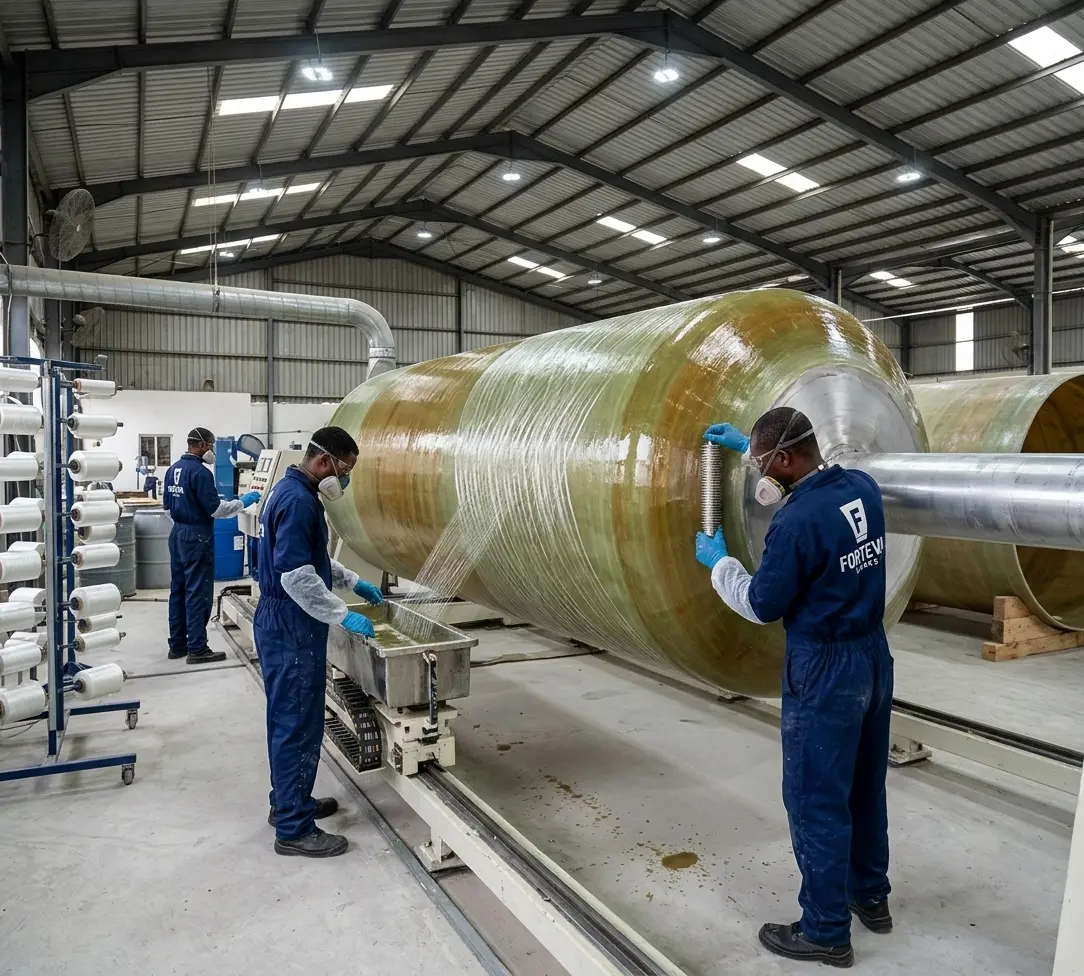
Filament winding lays continuous glass strands under tension. A machine winds them to an even wall. It suits round, hollow parts, such as chemical storage tank shells, high-pressure pipes and ducts. Of the four moulding methods we use, it gives the strongest part for its weight.
Hand lay-up builds the laminate by hand, layer by layer, in the mould. It suits any shape. It needs no special machine tooling. It is also the method for detailed parts: nozzles, T-joints, elbows, manways and internal seams.
Vertical or horizontal
A vertical tank stands upright on its base. A horizontal tank lies on its side.
We settle which one suits your site from the measurements we take there. Tell us if the tank has to sit beside existing pipework. Tell us too if it will stand inside a bund, the low wall that holds a spill around a tank.
Coatings and finishes
A tank can carry extra protection for where it stands:
- Outdoors, in the sun: a UV-resistant coating.
- Where there is a fire risk: a fire-resistant coating.
The outer surface can be smooth, textured or anti-slip. The tank can be made in a custom colour on request.
Pipes, process vessels and existing tanks
Where the tank connects to pipework or sits beside other vessels:
- Pipe to and from the tank: our GRP pipes and fittings are also made in vinyl ester for chemicals and acids.
- Process vessels, reaction tanks and water treatment tanks: see industrial storage tanks.
- An existing concrete or steel tank: it can be lined instead, through a manhole at least 600mm across, with fibreglass lining.
- Steel frames, platforms and pipe racks around the tank: see industrial blasting and painting.
- Drinking water: a different product, the bolted sectional FRP water tank in food-grade resin.
Oil and gas facilities can order chemical tanks with steel, safety equipment and tools through our procurement and supply service.
Installation and cover
Installation is added to the order if you ask for it. When we install the tank, the job carries 6 months of free routine servicing, cleaning and checks. It also carries 6 months of free repair of defects in materials and workmanship. Both are written into the contract. Damage from misuse, neglect or natural disasters is not covered. If we deliver and you install it, the tank carries 6 months of free repair of manufacturing defects, with no maintenance visits.
We work from Ogidan, Ajah, in Lagos, and take jobs across Nigeria.
What to send us for a quotation
Send three details with your enquiry:
- The chemical the tank will hold, by name, with its concentration and its temperature in the tank.
- The volume to be stored, in litres or cubic metres.
- The site location: the address and the state.
Four things move the cost of a chemical tank:
- project size and complexity
- the materials and finishes chosen
- customisation: shapes, sizes and colours
- the location and accessibility of the site
Send the three details through the enquiry form below, or reach us through our contact page.