
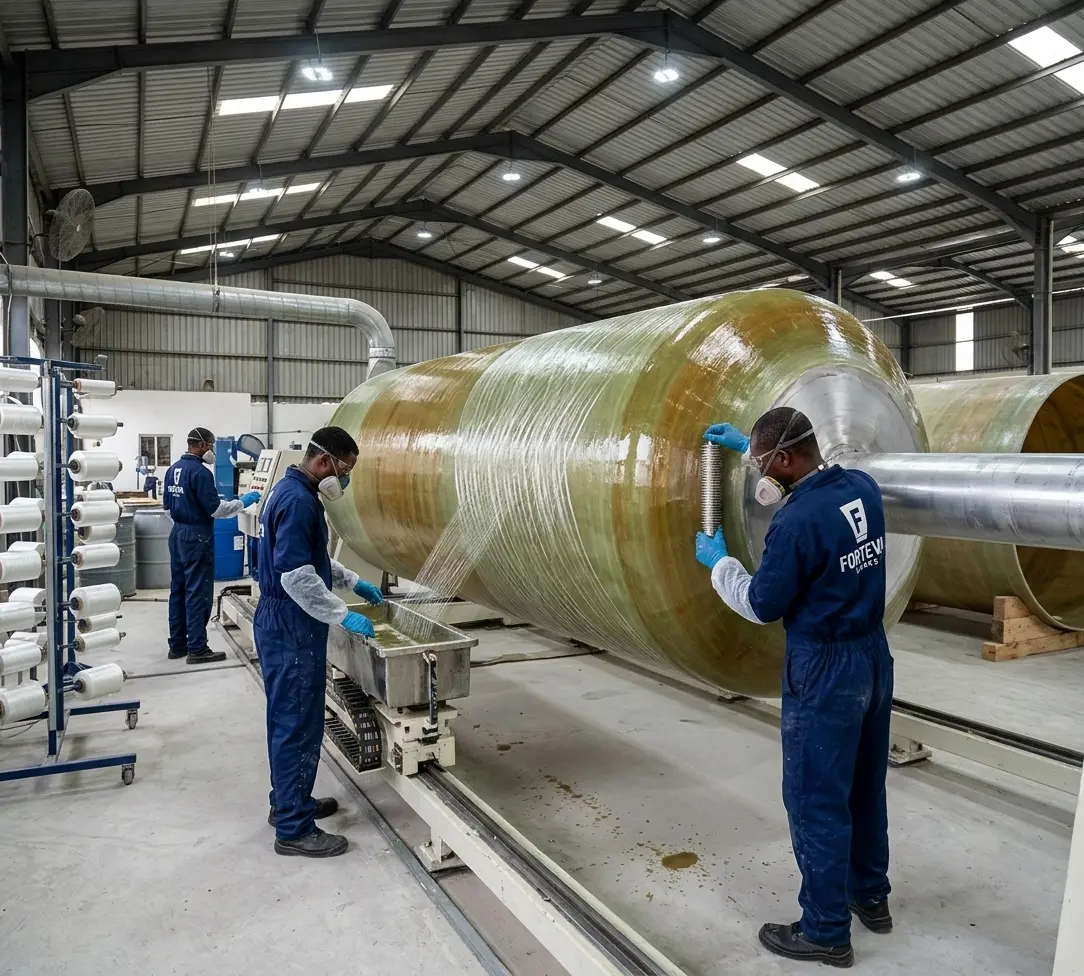
FortevaWorks makes industrial storage tanks in Nigeria for factories, food and beverage plants and oil and gas facilities. Most are FRP, which stands for fibre-reinforced plastic: resin strengthened with glass fibre, also called fibreglass. Some are steel, depending on what the tank holds and how it is used, and we advise which at the free site inspection. An FRP tank is moulded in our workshop and reaches your site finished, not as panels to bolt together.
Not the sectional water tank
Our FRP/GRP water tanks are sectional tanks. They are rectangular, built on site from SMC GRP panels joined with galvanised steel bolts. Those panels come from our manufacturing partner, and the tanks start at 5,000 litres.
Our Braithwaite tanks are sectional too. Their galvanised steel panels are coupled together on site. A Braithwaite tank suits a site that already has one and is adding a second beside it. FRP suits corrosive or salty water and air, and a buyer who wants no recoating.
An FRP industrial storage tank is made a different way. We build a custom mould from measurements taken on your site. The tank is moulded on it in our workshop, mostly as a cylinder.
For water storage built up from panels at an estate or building, start with the sectional tanks. For a tank or vessel that serves a factory process, a treatment plant or a chemical line, read on.
Bulk water storage
A factory or plant that holds water in bulk can have it in a vertical or a horizontal FRP cylinder. Which way the tank stands is settled at the free site inspection.
A tank that stands in an open yard can take a UV-resistant coating against the sun. A fire-resistant coating is available where the tank sits near a fire risk.
For water storage at estates and buildings, see our water storage systems service.
Water and wastewater treatment tanks
Treatment tanks are made to the size your treatment plant needs. The resin follows what the tank holds. Isophthalic polyester suits water use. Vinyl ester suits a tank that holds chemicals or acids. Wastewater is among the contents we build vinyl ester tanks for.
Tell us at the inspection what passes through each tank. The quotation then names the resin for it.
Process vessels and reaction tanks
Process vessels can be cylindrical or rectangular. Epoxy resin is used where a vessel needs high strength. Extra reinforcement layers can also be added to the laminate, the wall of glass and resin.
For the pipework between tanks, we make GRP/FRP pipes and fittings: pipe, bends, tees, flanges and reducers.
Choosing the resin
The resin is the part of the wall that meets what the tank holds. We choose it by contents:
- Isophthalic polyester: general and water use.
- Food-grade resin: water storage. It is the kind used for drinking water, so the tank won’t taint what it stores.
- Vinyl ester: chemicals and acids.
- Epoxy: where high strength is needed.
The resin named in your quotation is the resin in your tank. We do not swap it for a cheaper one after you sign.
Tanks for chemicals
Tanks for acids, alkalis and solvents are made with vinyl ester, the resin we use for chemicals and acids. For sulfuric acid, hydrochloric acid, caustic soda and similar contents, see our chemical storage tanks.
How a tank shell is made
We mould tanks by filament winding or hand lay-up. The method for each tank is chosen per project.
Filament winding suits round, hollow shells. A machine winds continuous glass strands under tension around the mould. The wall comes out even, and of our four moulding methods it gives the strongest part for its weight.
Hand lay-up builds the wall by hand, layer by layer, from glass and resin. It suits any shape. It needs no special machine tooling.
The full set of moulding methods is on our FRP/GRP composite fabrication page.
Finish and colour
The surface can be smooth, textured or anti-slip. Custom colours are made on request.
Checks before handover
Every tank is inspected for dimensional accuracy, surface finish and structural integrity. We check by visual inspection and by measuring. Each test follows the resin and material manufacturers’ specifications.
When the existing tank can stay
A concrete or steel tank, pit or sump that still stands can be lined inside with FRP/GRP instead of replaced. Lining needs a manhole at least 600mm across, and any leak repaired first. See fibreglass lining.
A steel tank whose coating has failed can be blasted to bare steel and recoated inside and outside. See industrial blasting and painting.
Fabricated tanks can also be ordered with other project materials through our procurement and supply service.
What decides the cost
Four things move the cost of an industrial tank:
- project size and complexity
- materials and finishes chosen
- customisation (shapes, sizes, colours)
- location and accessibility of the site
Your figure comes after the free site inspection.
What to send us
We work from Ogidan, Ajah, in Lagos, and take jobs across Nigeria.
To book the inspection, contact us with:
- what each tank will hold, with chemicals named
- the size you need, in litres or metres
- whether the tank stands indoors or in an open yard
- whether you want us to install it
- any existing tank you want lined or recoated instead
- your site address and state