
FortevaWorks supplies, installs and maintains Braithwaite tanks in Nigeria. A Braithwaite tank arrives as galvanised steel panels, which are coupled together on your site. We supply them in all sizes, built up from panels to the storage your site needs.
What a Braithwaite tank is
A Braithwaite tank is a water tank built from galvanised steel panels. The panels are delivered to site and coupled together where the tank will stand. Galvanised means the steel carries a zinc coating that protects it from rust.
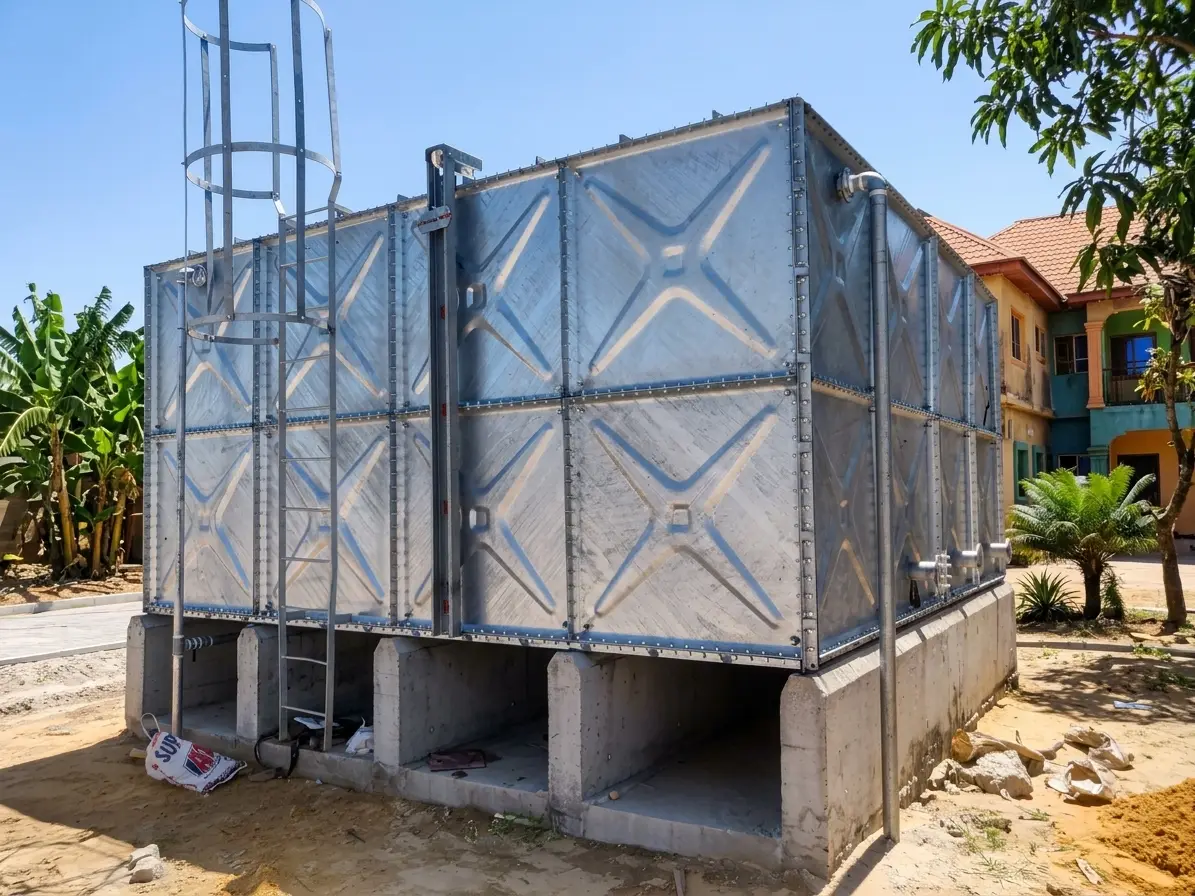
“Braithwaite” is the name widely used in Nigeria for this kind of tank. We use it for the tank type, not for any one maker’s product. “Pressed steel tank”, “sectional steel tank” and “Braithwaite tank” on a drawing or bill of quantities mean the same thing.
The tank goes up the same way as our FRP/GRP sectional tank: panels first, then coupled on site. Because it is built from panels, there is no one fixed size.
Braithwaite or FRP: what we recommend
FRP stands for fibre-reinforced plastic and GRP for glass-reinforced plastic. Both name the same material. A Braithwaite tank and an FRP/GRP tank are both built from panels coupled on site. The choice turns on four things: your specification, what already stands on site, how the panels reach the tank, and the water and air around it. Our Braithwaite vs FRP tank guide sets the two side by side.
We recommend a Braithwaite tank when
- Your specification names steel. A consultant’s drawings or a main contractor’s bill of quantities may call for a pressed steel tank. We supply and install to that specification. The material in the quotation is the material we install.
- Your site already has a Braithwaite tank. We extend FRP/GRP sectional tanks only. A site with a Braithwaite tank adds a second tank beside it, and a Braithwaite tank matches the one already there.
- The panels may be knocked. Steel panels are heavier and stiffer than GRP panels, and they take knocks better. That counts in a factory yard where vehicles and pallets pass close to the tank.
We recommend FRP when
- The water or the air is salty. GRP panels are corrosion-resistant. A Braithwaite tank’s panels rely on their galvanised coating, and a scratch or a worn patch in that coating can rust. Where the water is salty, or the tank stands in salt air near the coast, we recommend FRP.
- The tank goes on a roof, or access is tight. GRP panels are lighter than steel panels. They are easier to carry up stairs, through a narrow gate or onto a rooftop.
- You want no recoating. A GRP panel has no galvanised coating to look after. A steel panel does.
Our FRP option uses SMC GRP panels made with food-grade resin, the kind used for drinking water. FortevaWorks has worked on more than 20 FRP/GRP tank installations for residential estates. The FRP/GRP water tanks page sets out its panels, capacities and accessories.
For Braithwaite, FRP and plastic tanks side by side, see how to choose a water tank in Nigeria. We give our recommendation for your site at the free site inspection.
Factory tanks that are not water tanks
A Braithwaite tank stores water. For chemicals, wastewater treatment or process work, a factory needs a different tank. Our industrial storage tanks are FRP tanks and vessels, mostly cylindrical, made in our Lagos workshop.
Sizing a Braithwaite tank
A Braithwaite tank is sized the same way as any water storage tank we install. Work it out in three steps:
- Count the people served. Residents on an estate, staff on a factory site.
- Multiply by the litres each person uses per day. The Nigerian Water Supply and Sanitation Policy uses 120 litres per person per day for urban supply.
- Multiply by the days of storage the site needs. We set this at the inspection, from how reliable your borehole, mains and power supply are.
On a factory site, add the water the process itself uses. We work out that figure with you at the inspection.
Estate managers whose water runs short can check their storage with our guide on water storage for estates. It compares the storage you have with the people now living on the estate.
Where the tank stands and how it is serviced
A Braithwaite tank stands above ground, on a cement base or a raised metal stanchion. We build the base or stanchion as part of the job, or you have it ready before we arrive. The stanchion is built to the height your site needs, set at the inspection.
A maintenance visit drains the tank, then cleans and disinfects the inside. Bolts, joints and fittings are checked for leaks on the same visit. Supply is kept on where a second tank can carry the site; otherwise it is off while the tank is drained.
Looking after the galvanised coating
On a Braithwaite tank, the zinc coating is what keeps rust off the panels. A scratch or a worn patch in it can rust. A Braithwaite tank lasts about 25 to 35 years, and how well the coating is kept up decides where it falls in that range.
Where the coating has failed on a Braithwaite tank, our industrial blasting and painting service works on steel tanks inside and outside, on your site. Old paint and rust are blasted off, then a protective coating goes back on.
What moves the cost
Three things move the cost of every job we quote: the size of the project, the cost of materials and the location. The figure for your tank comes from a free site inspection. A detailed quotation follows, with a technical drawing if you want one.
How the job runs, from quotation to handover, is set out on our water storage systems service page.
Braithwaite tanks across Nigeria
We work from Ogidan, Ajah, in Lagos, and take jobs across Nigeria.
To book the free site inspection, contact us. Send your site address, the number of people the tank serves and whether a Braithwaite tank already stands on the site.