
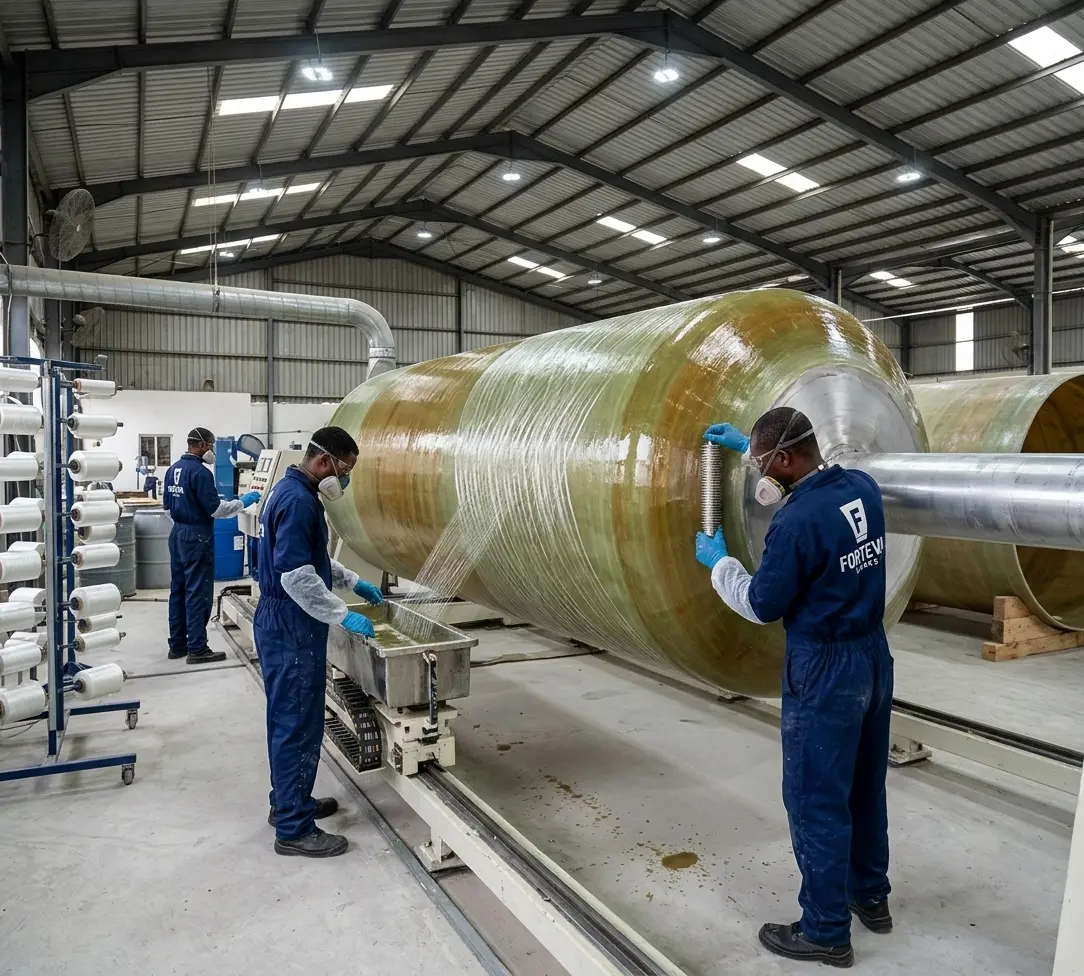
FortevaWorks makes GRP pipes and fittings in Nigeria in our Lagos workshop, then supplies and installs them. We make straight pipe plus bends, tees, flanges, reducers and other fittings. Every size and pressure rating is made to the client’s specification. Where the specification is still open, we advise.
GRP pipes and FRP pipes: one material, two names
GRP stands for glass-reinforced plastic. FRP stands for fibre-reinforced plastic. Both names describe glass fibre set in a resin. It is the same material as our FRP/GRP water tanks. A tender for FRP pipes and a tender for GRP pipes ask for the same product, and we quote either.
What to send for a quotation
Send what you have. There are two starting points.
You have a specification. Send it as it stands. Include the pipe sizes and the length of each run. Include the pressure rating. List every bend, tee, flange and reducer. Add any drawings or bill of quantities. We make to that document, and the quotation follows it line by line.
The specification is still open. Tell us what the line will carry: water, or the chemical or acid by name. Tell us where the line starts and where it ends. Tell us the site address and the state. We advise on the pressure rating and the resin from there.
In both cases, name any equipment the line connects to, such as a pump, a valve or a tank nozzle. Each of those usually joins the line at a flange.
For each fitting, give its type and how many you need. Give the pipe size at each end. A reducer has two sizes, so give both. A tee has a run and a branch, so give the size of each. For a flange, name what it joins: another pipe, a valve, a pump or a tank nozzle.
If the new line ties into existing pipework, tell us what that pipe is made of and its size. A photo of the route helps if the line runs along a wall, a rack or a trench.
The timeline is set in the quotation. We mobilise workers to site when we receive the first advance payment.
How the pipe is made: filament winding
Straight pipe is made by filament winding. A machine winds continuous glass strands under tension, wetted with resin. Continuous means each strand runs on without a break, unlike short chopped glass. The strands build the pipe wall up to an even thickness.
Filament winding suits round, hollow parts such as pipes and ducts. The glass runs in unbroken strands around the pipe, so the wall is strong for its weight. That is why it is the method for high-pressure pipe.
How the fittings are made: hand lay-up
Fittings are made by hand lay-up. Glass mat and woven cloth are laid into a mould by hand. Each layer is wetted with resin before the next goes on. The method suits any shape and needs no special machine tooling. A bend, tee or reducer changes shape along its length. Placing the glass by hand lets each layer follow that shape.
Each fitting does one job in the line:
- A bend changes the direction of the line.
- A tee branches the line, so one run becomes two.
- A reducer changes the pipe size, from a larger bore to a smaller one.
- A flange joins pipe to pipe, or pipe to equipment such as a valve, a pump or a tank nozzle.
Other fittings are made to the specification in the same way. Hand lay-up also makes nozzles, T-joints and elbows.
Where a fitting needs a new shape, we build a custom mould from site measurements. We take those measurements on your site. FortevaWorks builds the mould, makes the part from it and delivers the finished part. We keep the mould.
Resin follows what the line carries
The resin is the part of the pipe wall in contact with what flows through it. So the resin is chosen for what the line carries. We use two resins for pipe and fittings.
- Isophthalic polyester, for general use and for water.
- Vinyl ester, for chemicals and acids.
Where different runs carry different liquids, name the liquid for each run. We then set the resin run by run.
If you know what the line carries, we confirm the resin before we quote. If you are unsure, name the liquid and we advise. The resin is named in your quotation. The material in the quotation is the material we install. We do not swap it for a cheaper one after you sign.
Checking the laminate before you sign
Ask for a sample panel or a test coupon during the bid. Ask for it in the resin your quotation names. A test coupon is a small piece of the same laminate. You or your engineer can check it before you sign. Our tests follow the resin and material manufacturers’ specifications.
Supply and installation
We arrange the transport from our workshop to your site, in any state in Nigeria. Our crew offloads at site. Haulage is priced in the quotation.
Each delivery comes with a delivery note and a packing list. Every length of pipe and every fitting on the list can be counted at offload. Your representative and our supervisor check the delivery against the quotation. Both then sign the delivery note.
Our own crews install the line. Fittings and joints that must be made in place are laid up by hand on site.
When we install the line, the job carries six months of free routine servicing, cleaning and checks. It also carries six months of free repair of any defect in materials or workmanship. Both are written into the contract. Damage from misuse, neglect or natural disasters is not covered. If we deliver and you install them, the pipe and fittings carry 6 months of free repair of manufacturing defects, with no maintenance visits.
Pipe and fittings can also be ordered with other site materials through our procurement and supply service. That service has no minimum order. For the wider work done in the same Lagos workshop, see FRP/GRP composite fabrication.
The tanks a line connects to
A pipe line can start or end at a tank. We make tanks in the same Lagos workshop.
- Chemical tanks. A vinyl ester line can feed a tank holding the same chemical. Our chemical storage tanks use vinyl ester too, for acids, alkalis and industrial chemicals.
- Treatment and process vessels. Our industrial storage tanks include water and wastewater treatment tanks, process vessels and reaction tanks.
Where a line connects to an existing concrete or steel tank, pit or sump, that tank can be given a fibreglass lining. Steel pipework and pipe racks that stay in place can be blasted and recoated through our industrial blasting and painting service.
What decides the cost
Four things move the cost of a pipe job:
- the size and complexity of the project
- the materials and finishes chosen, starting with the resin
- how much is custom: shape, size and colour
- the location of the site, and how easy it is to reach
Custom work grows with each new fitting shape that needs its own mould. Your figure comes in the quotation, set against your specification.
Where we work
We work from Ogidan, Ajah, in Lagos, and take jobs across Nigeria.
To start, contact us with your specification, or with what the line will carry and the site address.